Fast facts
| Trade code | 332A |
|---|---|
| Sector | Service |
| Classification | Compulsory trade (O. Reg. 876/21, s. 2) |
| Certifying exam | Required (O. Reg. 876/21, s. 3) |
| Apprentice to journeyperson ratio | Not subject to a ratio |
| Red Seal trade | No |
| Active apprentices in Ontario | 7,496 (reported in Ontario's apprenticeship dataset) |
| Approved sponsors | 4,071 |
| Certifying body | Skilled Trades Ontario |
Last verified against the sources listed below.
Do you need a licence to work as a hairstylist in Ontario?
Yes. Hairstylist (332A) is a compulsory trade, so doing the work legally takes a licence. In Ontario that licence is the Certificate of Qualification, usually called a C of Q, issued by Skilled Trades Ontario. While you train, your registered apprenticeship is what lets you work.
How to get your hairstylist licence
- Find a sponsor, usually an employer or union, and register as an apprentice.
- Complete the on the job and in school training set by the trade's training standard.
- Pass the certifying exam. Passing it earns your C of Q. You book it in your Skilled Trades Ontario Portal ($150 plus HST) and write it at one of 24 exam centres: how to book it and find the nearest centre.
- Renew the certificate every year to keep working in the trade.
Hiring a hairstylist? Anyone can check whether a person holds a valid certificate on the Skilled Trades Ontario Public Register. The steps, hours and exam are explained in detail below, and every compulsory trade is on the list of compulsory trades.
Practice exam for this trade
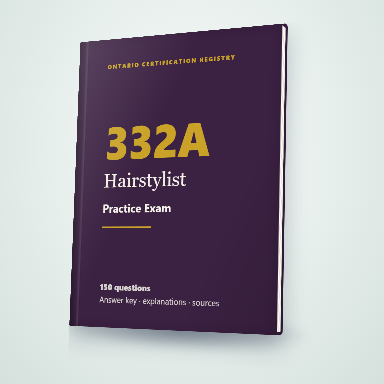
Hairstylist (332A) Practice Exam
Try 30 questions free with your score and explanations. Full 150-question PDF $67.49 CAD, one payment.
Try 30 questions freeSee the PDF
Independent study aid. Not affiliated with Skilled Trades Ontario, TSSA or the Red Seal Program.
What does a hairstylist do?
A Hairstylist performs a range of hairstyling services including cutting, designing colouring, permanent waving, relaxing and straightening.
Skilled Trades Ontario describes the work of this trade as follows:
- performs health, safety and sanitization procedures
- performs routine salon functions and service fundamentals
- treats scalp and hair
- cuts and styles hair
- performs chemical treatments such as waving, relaxing, and straightening
- performs colour services
- works with wigs, hairpieces and extensions
How long is the hairstylist apprenticeship?
The in-school portion of this apprenticeship runs to 2 levels. Skilled Trades Ontario does not publish a total hour requirement for this trade on its trade page; confirm the current requirement in the trade's apprenticeship training standard before signing an agreement.
What do you study in school for the 332A?
The in-school portion covers, but is not limited to:
- applied health and safety procedures
- treatment of hair and scalp
- salon functions
- cutting and styling hair
- chemical waving and relaxing of hair
- colouring and lightening hair
Is hairstylist a compulsory trade in Ontario?
Yes. Hairstylist is one of the 23 trades classified as compulsory by section 2 of O. Reg. 876/21 under the Building Opportunities in the Skilled Trades Act, 2021. To practice a compulsory trade legally in Ontario, a person must hold a Certificate of Qualification, a Provisional Certificate of Qualification, or a Registered Training Agreement, and their information appears on the Skilled Trades Ontario Public Register, where anyone can check whether a specific person is certified.
Working in this trade without one of those three documents is an offence, subject to limited exemptions such as approved pre-apprenticeship program participants. See the full list of compulsory trades in Ontario for how this trade compares to the other 22.
How do you become a hairstylist in Ontario?
The apprenticeship pathway for this trade is administered by Skilled Trades Ontario under section 14 of the Building Opportunities in the Skilled Trades Act, 2021:
- Find a sponsor and register a training agreement. An employer or union sponsor takes you on and the training agreement is registered with the ministry. For this trade the Registered Training Agreement is also your legal authorization to work while you train.
- Complete the on the job and in school training. The skills are set out in the trade's Apprenticeship Training Standard, signed off by your sponsor as you demonstrate them, alongside levels of in school theory at a training delivery agent.
- Receive your Certificate of Apprenticeship. Skilled Trades Ontario issues it when the program is complete.
- Pass the certifying exam. This trade has a certifying exam under O. Reg. 876/21, s. 3. Passing it earns the Certificate of Qualification, which compulsory trade workers must then hold and renew to keep practicing. How to book the exam and where to write it.
The exact training standard, current curriculum and program details are on the Skilled Trades Ontario page for Hairstylist. On the job hour requirements vary by trade and are not published on this page yet; confirm them in the training standard before signing an agreement.
Is the 332A a Red Seal trade?
No. Hairstylist is an Ontario prescribed trade but is not part of the Interprovincial Red Seal Program, so an Ontario credential in this trade does not carry automatic recognition in other provinces. Workers moving to another province should check that province's own trade classification.
Try the 30-question free practice test for this trade
How often does the certificate need to be renewed?
Journeypersons in compulsory trades must renew their Certificate of Qualification every year, per Skilled Trades Ontario. A lapsed certificate in a compulsory trade means the holder is no longer legally entitled to practice the trade until it is restored, so the renewal date is worth tracking ahead of time. The current renewal fee is not published on this page yet; confirm it with Skilled Trades Ontario.
Already experienced? The Trade Equivalency Assessment
Workers with experience from outside Ontario's apprenticeship system, or from another country, can apply for a Trade Equivalency Assessment instead of starting an apprenticeship. Approval requires verifiable evidence of competency in the trade's Training Standard and experience at least equal to the trade's total training time; if approved, you challenge the certifying exam directly. The assessment costs $235 plus HST, and a reassessment with new evidence costs $100 plus HST, per Skilled Trades Ontario's Trade Equivalency Assessment page.
Certification is not the only paperwork
A Certificate of Qualification covers the person. Running a business in the trade carries its own obligations: many Ontario municipalities require a contractor licence on top of personal certification, and construction employers must complete WSIB registration before work begins. Both are indexed on our sister site: municipal contractor licensing requirements by city and WSIB Form 1000, registration of constructors and employers, on Ontario Trade Registry.
What does a hairstylist earn in Ontario?
| Median wage | $18.00 per hour |
|---|---|
| Low | $17.60 |
| High | $28.57 |
| Occupation measured | Hairstylists and barbers (NOC 63210) |
| Reference period | 2023-2024 |
Published by Employment and Social Development Canada through Job Bank, for Ontario as a whole. Read it as the pay range for the occupational group this trade belongs to, not a guaranteed rate: one NOC code can cover more than one trade, and wages vary by region, employer and experience.
A note on this trade's Red Seal status
Two official sources disagree here. Ontario's apprenticeship dataset flags this as a Red Seal trade, but red-seal.ca does not list Ontario among the provinces that designate it. This page follows red-seal.ca, which is maintained by the Canadian Council of Directors of Apprenticeship, the body that runs the Red Seal Program. Confirm your own position with Skilled Trades Ontario before relying on it for interprovincial recognition.
Is the 332A recognised outside Ontario?
This trade has been part of the Interprovincial Red Seal Program since 1986. 12 of Canada's 13 provinces and territories designate it Red Seal: AB, BC, MB, NB, NL, NS, NT, NU, PE, QC, SK, YT, which does NOT include Ontario. Its National Occupational Classification code is 63210, which is how federal labour market data refers to this occupation.
Where can you train as a hairstylist in Ontario?
| Public training providers | 12 colleges deliver the in-school portion |
|---|---|
| Private training providers | 2 |
| Approved sponsors | 4,071 employers registered to train apprentices |
| Apprentices in training | 7,496 |
Counts are from Ontario's published apprenticeships dataset. A sponsor is the employer or union that registers and trains the apprentice; you need one before an apprenticeship can start.
Related Ontario trades
Other service sector trades with certification records on this registry:
Official verification sources
- RegulationO. Reg. 876/21, Prescribed Trades and Related Matters (e-Laws)
- Certifying bodySkilled Trades Ontario: Hairstylist
- ActBuilding Opportunities in the Skilled Trades Act, 2021 (e-Laws)
- WagesJob Bank wage data, Employment and Social Development Canada
- Red Seal profilered-seal.ca: Hairstylist trade profile
- Participation dataOntario open data: Apprenticeships dataset
Classification, exam requirement and ratio status on this page are read directly from O. Reg. 876/21 as consolidated on e-Laws, not from secondary summaries. Facts not yet verified against a primary source are marked as not published rather than estimated.