Free practice test
Try 30 questions free
Work through 30 questions, then see your score, results by topic and an explanation for every answer. No account or email needed.
These are 30 of the 150 questions in the full PDF. You can also read the questions and answers below.
The full 150-question PDF
Includes the 30 free questions plus 120 additional questions, explanations and references. One payment, no subscription.
| Questions | 150, all original |
|---|---|
| Answer key | Correct answer, the reasoning, and a cited source for each question |
| Distinct references | 76 distinct citations across the bank |
| Free samples here | 30, with answers, below |
| Format | PDF, emailed on purchase, plus a download link valid 30 days |
| Price | $67.49 CAD, one payment, no subscription |
Payment is handled by Stripe. This is study material, not an official exam, and it is not affiliated with Skilled Trades Ontario, TSSA or the Red Seal program.
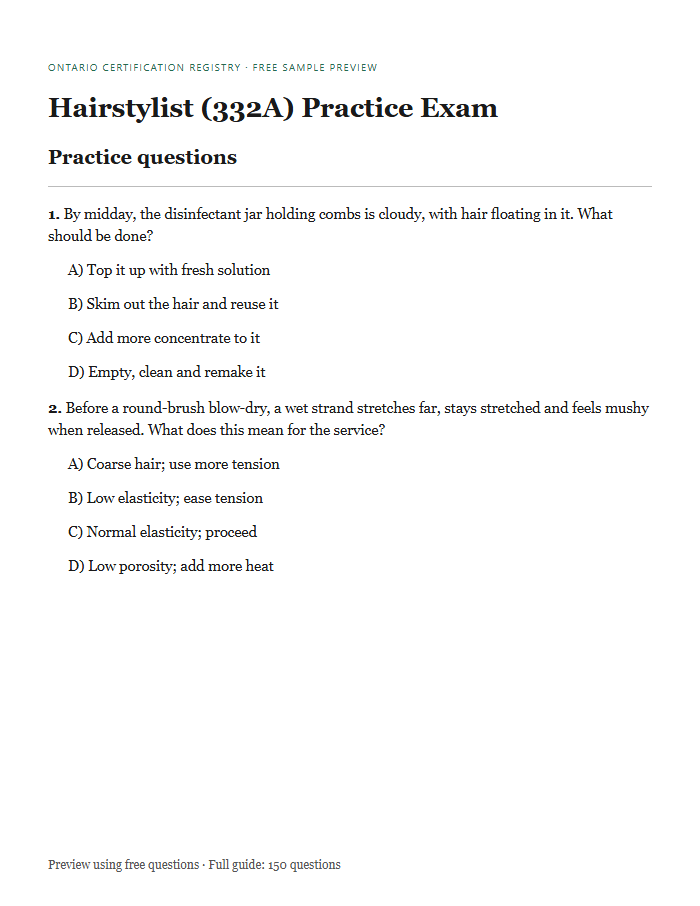
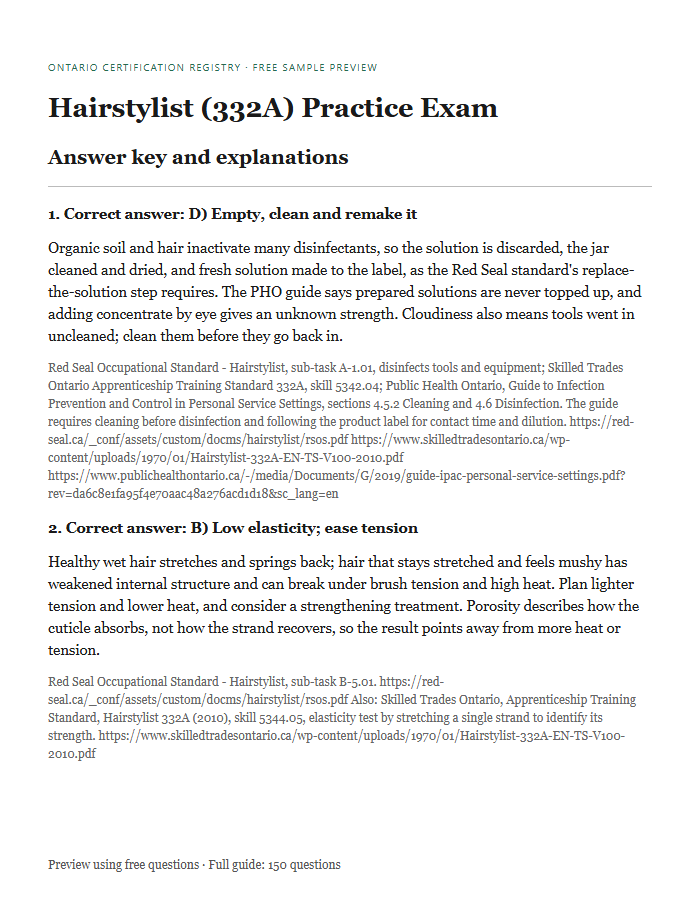
Look inside the PDF
A preview of the question and answer-key layout, using questions from the free sample. The full guide contains all 150 questions.
What this guide covers
Editorial study coverage is scaled from the national Red Seal Hairstylist page's published activity counts (120-question breakdown) to 150 using whole-question rounding; the A/G half-question tie is assigned to A. This is not an Ontario 332A examination blueprint. Ontario currently provides a provincial Certificate of Qualification without a Red Seal Endorsement. Question types use an editorial study mix, not an official Ontario examination distribution. The table shows the actual counts and shares in this guide.
| Major work activity | Questions here | Share of this guide |
|---|---|---|
| A. Common occupational skills | 18 | 12% |
| B. Hair and scalp care | 14 | 9.3% |
| C. Cuts hair | 30 | 20% |
| D. Styles hair | 20 | 13.3% |
| E. Chemical texture services | 21 | 14% |
| F. Hair colour services | 31 | 20.7% |
| G. Specialized services | 7 | 4.7% |
| H. Salon operations | 9 | 6% |
Coverage source: Occupational study coverage reference
The mix of question types
This is our editorial study mix, not an official examination distribution.
| Type | Questions here | Share |
|---|---|---|
| Knowledge and recall | 25 | 16.7% |
| Procedural and application | 117 | 78% |
| Critical thinking | 8 | 5.3% |
30 free sample questions from the Hairstylist bank
This fixed selection comes straight from the bank and covers every major work activity, with the answers and sources shown. Read them before you decide whether the rest is worth $67.49 to you.
Question 1: By midday, the disinfectant jar holding combs is cloudy, with hair floating in it. What should be done?
Sample 1 · Activity A
By midday, the disinfectant jar holding combs is cloudy, with hair floating in it. What should be done?
- Top it up with fresh solution
- Skim out the hair and reuse it
- Add more concentrate to it
- Empty, clean and remake it (correct)
Organic soil and hair inactivate many disinfectants, so the solution is discarded, the jar cleaned and dried, and fresh solution made to the label, as the Red Seal standard's replace-the-solution step requires. The PHO guide says prepared solutions are never topped up, and adding concentrate by eye gives an unknown strength. Cloudiness also means tools went in uncleaned; clean them before they go back in.
Red Seal Occupational Standard - Hairstylist, sub-task A-1.01, disinfects tools and equipment; Skilled Trades Ontario Apprenticeship Training Standard 332A, skill 5342.04; Public Health Ontario, Guide to Infection Prevention and Control in Personal Service Settings, sections 4.5.2 Cleaning and 4.6 Disinfection. The guide requires cleaning before disinfection and following the product label for contact time and dilution. https://red-seal.ca/_conf/assets/custom/docms/hairstylist/rsos.pdf https://www.skilledtradesontario.ca/wp-content/uploads/1970/01/Hairstylist-332A-EN-TS-V100-2010.pdf https://www.publichealthontario.ca/-/media/Documents/G/2019/guide-ipac-personal-service-settings.pdf?rev=da6c8e1fa95f4e70aac48a276acd1d18&sc_lang=en
Question 2: Besides a DIN, which label claim shows a disinfectant reaches intermediate-level disinfection?
Sample 2 · Activity A
Besides a DIN, which label claim shows a disinfectant reaches intermediate-level disinfection?
- Kills 99.9% of bacteria
- Hospital disinfectant
- Hard-surface disinfectant
- Tuberculocidal claim (correct)
The PHO guide defines an intermediate-level disinfectant as a low-level one that is also effective against mycobacteria, shown on the label by words such as mycobactericidal or tuberculocidal. 'Hospital disinfectant' and 'hard-surface disinfectant' also appear on low-level products, and a bacteria-kill claim says nothing about mycobacteria. Intermediate level is what tools that may break the skin need, such as shears or clipper blades that nicked a client.
Red Seal Occupational Standard - Hairstylist, sub-task A-1.01, disinfects tools and equipment; Skilled Trades Ontario Apprenticeship Training Standard 332A, skill 5342.04; Public Health Ontario, Guide to Infection Prevention and Control in Personal Service Settings, sections 4.5.2 Cleaning and 4.6 Disinfection. The guide requires cleaning before disinfection and following the product label for contact time and dilution. https://red-seal.ca/_conf/assets/custom/docms/hairstylist/rsos.pdf https://www.skilledtradesontario.ca/wp-content/uploads/1970/01/Hairstylist-332A-EN-TS-V100-2010.pdf https://www.publichealthontario.ca/-/media/Documents/G/2019/guide-ipac-personal-service-settings.pdf?rev=da6c8e1fa95f4e70aac48a276acd1d18&sc_lang=en
Question 3: Household bleach at 50,000 ppm available chlorine (5.25%) is diluted to 1,000 ppm for intermediate-level disinfection. How is 1 L mixed?
Sample 3 · Activity A
Household bleach at 50,000 ppm available chlorine (5.25%) is diluted to 1,000 ppm for intermediate-level disinfection. How is 1 L mixed?
- 20 mL bleach, 980 mL water (correct)
- 200 mL bleach, 800 mL water
- 100 mL bleach, 900 mL water
- 2 mL bleach, 998 mL water
50,000 / 1,000 = 50, so 1 L needs 1,000 mL / 50 = 20 mL of bleach made up to 1 L with 980 mL of water, the PHO guide's 1:50 mix. 2 mL is the 1:500 low-level mix (100 ppm), 100 mL is the 1:10 high-level mix (5,000 ppm), and 200 mL comes from reading 1,000 ppm as 1%. The guide sets a 10-minute contact time and a fresh bleach solution each day.
Red Seal Occupational Standard - Hairstylist, sub-task A-1.01, disinfects tools and equipment; Skilled Trades Ontario Apprenticeship Training Standard 332A, skill 5342.04; Public Health Ontario, Guide to Infection Prevention and Control in Personal Service Settings, sections 4.5.2 Cleaning and 4.6 Disinfection. The guide requires cleaning before disinfection and following the product label for contact time and dilution. https://red-seal.ca/_conf/assets/custom/docms/hairstylist/rsos.pdf https://www.skilledtradesontario.ca/wp-content/uploads/1970/01/Hairstylist-332A-EN-TS-V100-2010.pdf https://www.publichealthontario.ca/-/media/Documents/G/2019/guide-ipac-personal-service-settings.pdf?rev=da6c8e1fa95f4e70aac48a276acd1d18&sc_lang=en
Question 4: A client's neckline is nicked during a clipper edge-up. Which styptic does the PHO guide permit?
Sample 4 · Activity A
A client's neckline is nicked during a clipper edge-up. Which styptic does the PHO guide permit?
- Single-use styptic, discarded (correct)
- Styptic powder on a reused puff
- Alum block rinsed between uses
- Styptic pencil, wiped after use
The PHO guide makes styptic products and their applicators single-use, discarded after each client, with no double-dipping, and that applies to solid, liquid and powder styptics alike. It bans multi-use styptic pencils because they become contaminated with blood and can carry microorganisms to the next client, which is also why a shared alum block or reused puff fails. Wear gloves to apply it and do hand hygiene afterwards.
Red Seal Occupational Standard - Hairstylist, sub-task A-1.01, disinfects tools and equipment; Skilled Trades Ontario Apprenticeship Training Standard 332A, skill 5342.04; Public Health Ontario, Guide to Infection Prevention and Control in Personal Service Settings, sections 4.5.2 Cleaning and 4.6 Disinfection. The guide requires cleaning before disinfection and following the product label for contact time and dilution. https://red-seal.ca/_conf/assets/custom/docms/hairstylist/rsos.pdf https://www.skilledtradesontario.ca/wp-content/uploads/1970/01/Hairstylist-332A-EN-TS-V100-2010.pdf https://www.publichealthontario.ca/-/media/Documents/G/2019/guide-ipac-personal-service-settings.pdf?rev=da6c8e1fa95f4e70aac48a276acd1d18&sc_lang=en Also: Public Health Ontario, Guide to Infection Prevention and Control in Personal Service Settings, 3rd edition (2019), section 5.5, Safe Use and Storage of Products Used on Clients (styptic products and applicators), and Appendix G. https://www.publichealthontario.ca/-/media/Documents/G/2019/guide-ipac-personal-service-settings.pdf?rev=da6c8e1fa95f4e70aac48a276acd1d18&sc_lang=en
Question 5: Before a round-brush blow-dry, a wet strand stretches far, stays stretched and feels mushy when released. What does this mean for the service?
Sample 5 · Activity B
Before a round-brush blow-dry, a wet strand stretches far, stays stretched and feels mushy when released. What does this mean for the service?
- Coarse hair; use more tension
- Low elasticity; ease tension (correct)
- Normal elasticity; proceed
- Low porosity; add more heat
Healthy wet hair stretches and springs back; hair that stays stretched and feels mushy has weakened internal structure and can break under brush tension and high heat. Plan lighter tension and lower heat, and consider a strengthening treatment. Porosity describes how the cuticle absorbs, not how the strand recovers, so the result points away from more heat or tension.
Red Seal Occupational Standard - Hairstylist, sub-task B-5.01. https://red-seal.ca/_conf/assets/custom/docms/hairstylist/rsos.pdf Also: Skilled Trades Ontario, Apprenticeship Training Standard, Hairstylist 332A (2010), skill 5344.05, elasticity test by stretching a single strand to identify its strength. https://www.skilledtradesontario.ca/wp-content/uploads/1970/01/Hairstylist-332A-EN-TS-V100-2010.pdf
Question 6: A client wanting highlights has used a gradual grey-coverage cream for months. In a peroxide and ammonia test, her strand heats, bubbles and discolours. What does this show?
Sample 6 · Activity B
A client wanting highlights has used a gradual grey-coverage cream for months. In a peroxide and ammonia test, her strand heats, bubbles and discolours. What does this show?
- High porosity; use a filler
- Low elasticity; bond builder
- Resistant grey; pre-soften it
- Metallic salts; do not lighten (correct)
Heat, bubbling and discolouration when a strand meets peroxide and ammonia are the classic signs of metallic salts, which some gradual colour creams leave in the hair. Lightener or oxidation colour on that hair can overheat, discolour or break it, so the service is declined for the affected lengths. Porosity, resistant grey and elasticity are judged by feel, colour and stretch, not by a heat reaction, and the test speaks only for the strand tested.
Red Seal Occupational Standard - Hairstylist, sub-task B-5.02. https://red-seal.ca/_conf/assets/custom/docms/hairstylist/rsos.pdf
Question 7: Which structure gives hair most of its strength and elasticity and holds its natural pigment?
Sample 7 · Activity B
Which structure gives hair most of its strength and elasticity and holds its natural pigment?
- The medulla
- The cuticle
- The cortex (correct)
- The dermal papilla
The cortex, the middle layer of the shaft, holds the melanin and the keratin bonds that give strength and elasticity, which is why colour and texture services act there. The cuticle is the overlapping protective outer layer, the medulla is an inner core that can be absent in fine hair, and the papilla sits at the base of the follicle and feeds growth. The Red Seal standard lists cuticle, cortex and medulla as the structure of hair.
Red Seal Occupational Standard - Hairstylist, sub-task B-5.01. https://red-seal.ca/_conf/assets/custom/docms/hairstylist/rsos.pdf
Question 8: Hair is 25 cm all over. The client wants shorter, lighter layers at the crown but a full-length perimeter. Which method fits?
Sample 8 · Activity C
Hair is 25 cm all over. The client wants shorter, lighter layers at the crown but a full-length perimeter. Which method fits?
- 180° to a stationary top guide (correct)
- 90° to a travelling guide
- 0° to a stationary nape guide
- 45° to a travelling guide
Lifting the hair straight up to 180° to a stationary guide at the top makes the crown shortest and lets lengths increase toward the perimeter, so the outline keeps its length. A 90° travelling guide cuts every hair to the layer length, shortening the perimeter too, 45° builds graduation and weight, and 0° gives no layers at all. Confirm the crown length with the client before setting the guide.
Red Seal Occupational Standard - Hairstylist, sub-task C-7.01. https://red-seal.ca/_conf/assets/custom/docms/hairstylist/rsos.pdf
Question 9: A client with a strong crown whorl wants the crown as short as possible while still lying flat. A test section cut to 4 cm stands straight up; one beside it left at 7 cm lies down. What does this evidence support?
Sample 9 · Activity C
A client with a strong crown whorl wants the crown as short as possible while still lying flat. A test section cut to 4 cm stands straight up; one beside it left at 7 cm lies down. What does this evidence support?
- Cut the whole crown to 4 cm
- Thin the whorl to reduce lift
- Add tension when cutting it
- Keep about 7 cm at the whorl (correct)
At 4 cm the whorl's growth direction lifts the hair, while at 7 cm the hair has enough weight to lie down, so the evidence supports leaving about that length at the whorl and agreeing it with the client. Thinning removes the weight that holds it flat and usually makes it stand more, and extra tension only makes the hair spring shorter when released. The test shows only these two lengths, so a length between them is untested.
Red Seal Occupational Standard - Hairstylist, sub-task C-7.03. https://red-seal.ca/_conf/assets/custom/docms/hairstylist/rsos.pdf
Question 10: Each section is held at 90° from the curve of the head and cut to a travelling guide. Which form results?
Sample 10 · Activity C
Each section is held at 90° from the curve of the head and cut to a travelling guide. Which form results?
- Uniform layers throughout (correct)
- A solid, one-length form
- A graduated, stacked form
- Long layers, longer perimeter
Holding every section straight out from the head at 90° and following a travelling guide cuts all the hair to the same length, giving uniform layers. Zero elevation gives a solid form, low to medium elevation builds graduation, and 180° to a stationary guide gives layers that lengthen toward the perimeter. The Red Seal standard has the stylist describe how elevations and angles shape the result.
Red Seal Occupational Standard - Hairstylist, sub-task C-7.01. https://red-seal.ca/_conf/assets/custom/docms/hairstylist/rsos.pdf
Question 11: A client wants a straight fringe. A strong cowlick at the front hairline lifts the centre up and to one side. How should the fringe be cut?
Sample 11 · Activity C
A client wants a straight fringe. A strong cowlick at the front hairline lifts the centre up and to one side. How should the fringe be cut?
- Thinned close to the root
- Longer, with little tension (correct)
- Combed flat wet and blunt cut
- Shorter, at full tension
A cowlick springs the hair up once it is released, so a fringe combed flat and cut under tension ends up shorter and lifts; leaving it longer, cut with little or no tension and checked dry, lets its weight work against the lift. Thinning near the root leaves short hairs that stand up even more. If a straight fringe still will not sit, suggest a direction that follows the cowlick.
Red Seal Occupational Standard - Hairstylist, sub-task C-7.01. https://red-seal.ca/_conf/assets/custom/docms/hairstylist/rsos.pdf
Question 12: Which cutting technique leaves a deliberate jump in length between two areas, with no blending between them?
Sample 12 · Activity C
Which cutting technique leaves a deliberate jump in length between two areas, with no blending between them?
- Tapering
- Graduation
- Point cutting
- Disconnection (correct)
A disconnected cut leaves the longer lengths deliberately unrelated to a shorter area, such as a long top over a short undercut, and the Red Seal standard lists disconnection among cutting techniques. Graduation and tapering blend length gradually from one area to the next, and point cutting only softens the ends.
Red Seal Occupational Standard - Hairstylist, sub-task C-7.01. https://red-seal.ca/_conf/assets/custom/docms/hairstylist/rsos.pdf
Question 13: After a one-length bob, the line is level everywhere except just above one ear, where it sits higher. What most likely caused this?
Sample 13 · Activity C
After a one-length bob, the line is level everywhere except just above one ear, where it sits higher. What most likely caused this?
- Tension over the ear (correct)
- Guide cut too short
- Head tilted forward
- Hair dried before checking
The ear pushes the hair outward, so hair combed down tightly over it and cut under tension springs up when released, leaving a high spot only there; that area is cut with little or no tension, letting the hair sit over the ear. A short guide or a moisture change would affect the whole line, and a forward head tilt changes the nape, not one ear. The Red Seal standard has tension controlled through the cut to keep the line even.
Red Seal Occupational Standard - Hairstylist, sub-task C-7.02. https://red-seal.ca/_conf/assets/custom/docms/hairstylist/rsos.pdf
Question 14: A client with fine, flat hair wants lift at the roots that lasts through an evening event. Which styling aid suits the base?
Sample 14 · Activity D
A client with fine, flat hair wants lift at the roots that lasts through an evening event. Which styling aid suits the base?
- Firm-hold styling wax
- Heavy styling pomade
- Volumizing root spray (correct)
- Silicone shine serum
Root sprays and volumizers are made to add body at the base without weight, which fine hair needs to hold lift; the Red Seal standard has aids chosen by texture, density and desired result. Serum, pomade and wax add weight and shine, so at the roots they flatten fine hair. Finish with a flexible-hold spray so the style lasts the evening.
Red Seal Occupational Standard - Hairstylist, sub-task D-10.01. https://red-seal.ca/_conf/assets/custom/docms/hairstylist/rsos.pdf
Question 15: Both sides were curled with the same iron, setting, section size and tension. The left curls were pinned to cool; the right curls were brushed out hot. Twenty minutes later only the right side has dropped. What explains it?
Sample 15 · Activity D
Both sides were curled with the same iron, setting, section size and tension. The left curls were pinned to cool; the right curls were brushed out hot. Twenty minutes later only the right side has dropped. What explains it?
- Heat set too low for the hair
- Too little tension on the right
- Sections too large to hold
- Curls released before cooling (correct)
Heat reshapes the hair's temporary bonds, and they set in the new shape as the hair cools, so curls brushed out hot relax while pinned curls hold. Tension, heat setting and section size were the same on both sides, so none of them can explain a difference that shows only on the right. The Ontario standard has thermal curls cool without the base being disturbed.
Red Seal Occupational Standard - Hairstylist, sub-task D-10.02. https://red-seal.ca/_conf/assets/custom/docms/hairstylist/rsos.pdf; Ontario Hairstylist Apprenticeship Training Standard (2010), competency 5347.05, printed page 33: heat selection, comb barrier, pressure/tension and cooling without disturbing the base. https://www.skilledtradesontario.ca/wp-content/uploads/1970/01/Hairstylist-332A-EN-TS-V100-2010.pdf
Question 16: Which wet-set technique shapes damp hair into alternating ridges using only a comb and the hands, with no heat tools?
Sample 16 · Activity D
Which wet-set technique shapes damp hair into alternating ridges using only a comb and the hands, with no heat tools?
- Marcel waving
- Roller setting
- Sculpted pin curls
- Finger waving (correct)
Finger waving moulds damp hair with a comb and fingers into alternating C-shapes joined by ridges, without heat, which is how the Ontario training standard's glossary defines a finger wave. Marcel waving forms similar waves but with heated irons on dry hair, and pin curls are sculpted into circles rather than continuous ridges. The set is then dried, usually under a hood dryer.
Red Seal Occupational Standard - Hairstylist, sub-task D-9.05. https://red-seal.ca/_conf/assets/custom/docms/hairstylist/rsos.pdf
Question 17: A client with fragile, frizz-prone hair wants a smooth blow-dry. How should the dryer's airflow be aimed?
Sample 17 · Activity D
A client with fragile, frizz-prone hair wants a smooth blow-dry. How should the dryer's airflow be aimed?
- Held still on each section
- Down the shaft, roots to ends (correct)
- Up the shaft, ends to roots
- Straight onto the scalp
Air directed down the hair shaft from roots to ends lays the cuticle flat for smoothness, and keeping the dryer moving at a safe distance protects fragile hair. Blowing from the ends toward the roots roughs up the cuticle and adds frizz. The Red Seal safety practices direct airflow away from the scalp and keep a safe distance from the strand, which rules out the other two.
Red Seal Occupational Standard - Hairstylist, sub-task D-9.02. https://red-seal.ca/_conf/assets/custom/docms/hairstylist/rsos.pdf
Question 18: While a rod is being wound, the end paper slips and the hair ends bend back on themselves. What should be done?
Sample 18 · Activity E
While a rod is being wound, the end paper slips and the hair ends bend back on themselves. What should be done?
- Unwind and rewrap the ends (correct)
- Tighten the band to hold it
- Wind on; lotion will smooth it
- Add a second paper over it
Ends that bend back become fishhooks, frizzy hooked ends that the waving lotion fixes into the hair, so the rod is unwound and the ends rewrapped smoothly inside the end paper. The lotion sets whatever shape the ends are wound in rather than smoothing them, and a paper laid over a bent end leaves it bent. A tighter band can dent or break the hair at the base, which the Red Seal standard warns against.
Red Seal Occupational Standard - Hairstylist, sub-task E-11.01. https://red-seal.ca/_conf/assets/custom/docms/hairstylist/rsos.pdf
Question 19: Ten minutes into an alkaline wave, nape test curls show a firm S matching the rod size, but crown test curls show only a weak wave. Rods, wrap tension and saturation are the same throughout. The nape was highlighted last year; the crown is coarse and virgin. What explains the difference?
Sample 19 · Activity E
Ten minutes into an alkaline wave, nape test curls show a firm S matching the rod size, but crown test curls show only a weak wave. Rods, wrap tension and saturation are the same throughout. The nape was highlighted last year; the crown is coarse and virgin. What explains the difference?
- Processing time is too short
- Crown hair is more porous
- Waving lotion is too weak
- Nape hair is more porous (correct)
Lightened hair has a raised, weakened cuticle and absorbs waving lotion quickly, so the highlighted nape processes faster than the coarse, virgin crown, which resists. A weak lotion or a short time would slow every area equally, so neither explains a difference between areas. Allow for the porous area next time (for example with the pre-wrap or timing the maker directs) rather than one timing for the whole head.
Red Seal Occupational Standard - Hairstylist, sub-task E-11.02. https://red-seal.ca/_conf/assets/custom/docms/hairstylist/rsos.pdf
Question 20: In a thioglycolate permanent wave, what does the neutralizer do to the hair?
Sample 20 · Activity E
In a thioglycolate permanent wave, what does the neutralizer do to the hair?
- Sets hydrogen bonds
- Rejoins disulfide bonds (correct)
- Breaks disulfide bonds
- Raises the hair's pH
The waving lotion breaks disulfide bonds by reduction so the hair can take the rod's shape, and the neutralizer, an oxidizer, rejoins them in that new shape, which the Red Seal standard describes as re-forming bonds and stabilizing the hair. Hydrogen bonds re-form with water and drying alone and give only a temporary set. Raising pH is what the alkaline waving lotion does, not the neutralizer.
Red Seal Occupational Standard - Hairstylist, sub-task E-11.02. https://red-seal.ca/_conf/assets/custom/docms/hairstylist/rsos.pdf
Question 21: While waving lotion is being applied, the cotton strip around the hairline becomes saturated. What is done?
Sample 21 · Activity E
While waving lotion is being applied, the cotton strip around the hairline becomes saturated. What is done?
- Add barrier cream over it
- Press it dry with a towel
- Replace it with fresh cotton (correct)
- Leave it until the rinse
The Ontario training standard has the cotton strip replaced whenever it becomes saturated, because soaked cotton holds waving lotion against the skin and can irritate or burn it. Barrier cream goes on the skin before the cotton and cannot work over a wet strip, and pressing it with a towel leaves lotion in the cotton. Fresh cotton keeps protecting the hairline until the rinse.
Red Seal Occupational Standard - Hairstylist, sub-task E-11.02. https://red-seal.ca/_conf/assets/custom/docms/hairstylist/rsos.pdf Also: Skilled Trades Ontario, Apprenticeship Training Standard, Hairstylist 332A (2010), skill 5348.03 (replacing cotton strip whenever saturated). https://www.skilledtradesontario.ca/wp-content/uploads/1970/01/Hairstylist-332A-EN-TS-V100-2010.pdf
Question 22: Natural level 5 hair is to be coloured to level 8 with permanent colour. The line's chart: 10 vol deposits only, 20 vol lifts up to 2 levels, 30 vol up to 3, 40 vol up to 4. Using the gentlest developer that reaches the target, which is chosen?
Sample 22 · Activity F
Natural level 5 hair is to be coloured to level 8 with permanent colour. The line's chart: 10 vol deposits only, 20 vol lifts up to 2 levels, 30 vol up to 3, 40 vol up to 4. Using the gentlest developer that reaches the target, which is chosen?
- 40 volume
- 30 volume (correct)
- 20 volume
- 10 volume
Level 8 minus level 5 is 3 levels of lift. 20 vol stops at 2 levels, and 40 vol would reach it but is stronger than needed and adds damage, so 30 vol is the gentlest that works. A strand test confirms the hair can take the lift.
Red Seal Occupational Standard - Hairstylist, sub-task F-13.01. https://red-seal.ca/_conf/assets/custom/docms/hairstylist/rsos.pdf
Question 23: Correction strand tests on dark level 3 ends (target level 7): a colour remover reaches level 6 with good elasticity; lightener with 20 vol reaches level 7, but the strand snaps when gently stretched wet. What plan do the tests support?
Sample 23 · Activity F
Correction strand tests on dark level 3 ends (target level 7): a colour remover reaches level 6 with good elasticity; lightener with 20 vol reaches level 7, but the strand snaps when gently stretched wet. What plan do the tests support?
- Lightener to reach level 7
- Level 7 tint over the ends
- Remover, then lightener today
- Remover only; reassess later (correct)
The remover reached level 6 without harming elasticity, while the lightened strand broke, so the evidence supports removing colour now, stopping short of the target and reassessing condition before any further lift. Adding lightener after the remover stacks damage on hair the test showed is fragile, and a level 7 tint cannot lift level 3 artificial pigment.
Red Seal Occupational Standard - Hairstylist, sub-task F-15.01. https://red-seal.ca/_conf/assets/custom/docms/hairstylist/rsos.pdf
Question 24: As dark natural hair is lightened, in what order are the warm underlying pigments exposed?
Sample 24 · Activity F
As dark natural hair is lightened, in what order are the warm underlying pigments exposed?
- Red, then yellow, then orange
- Orange, then red, then yellow
- Red, then orange, then yellow (correct)
- Yellow, then orange, then red
Melanin breaks down in stages, so dark hair passes through red and red-orange, then orange and gold, and finally yellow and pale yellow as it lightens. The reversed order is the common slip: yellow is the last pigment left, which is why the lightest blondes are toned with violet. The exact tone at each level varies between colour lines' charts.
Red Seal Occupational Standard - Hairstylist, sub-task F-13.01. https://red-seal.ca/_conf/assets/custom/docms/hairstylist/rsos.pdf
Question 25: A client has had the same PPD-containing permanent colour every six weeks for two years with no reaction. Under the directions Canada requires for such dyes, when is the preliminary skin test made?
Sample 25 · Activity F
A client has had the same PPD-containing permanent colour every six weeks for two years with no reaction. Under the directions Canada requires for such dyes, when is the preliminary skin test made?
- Before every application (correct)
- At the first application
- Once every 12 months
- When the shade changes
Canada's Cosmetic Regulations require hair dyes containing p-phenylenediamine or other coal-tar dye bases to come with directions for a preliminary test (behind the ear or inner forearm, checked after 24 hours) made before each application. Sensitivity can develop after years of uneventful use, so a clean record does not exempt the client. Follow the product's own test method and timing.
Red Seal Occupational Standard - Hairstylist, sub-task F-13.01. https://red-seal.ca/_conf/assets/custom/docms/hairstylist/rsos.pdf Also: Cosmetic Regulations, C.R.C., c. 869, section 22 (caution and preliminary test directions for hair dyes containing p-phenylenediamine or other coal-tar dye bases), current to 2026-10-19. https://laws-lois.justice.gc.ca/eng/regulations/C.R.C.,_c._869/FullText.html
Question 26: Highlights were lifted to level 8, which shows yellow-orange. A violet toner was applied for a cool level 9 blonde, but the result still looks brassy. Mixing and timing followed the directions. What is the most likely cause?
Sample 26 · Activity F
Highlights were lifted to level 8, which shows yellow-orange. A violet toner was applied for a cool level 9 blonde, but the result still looks brassy. Mixing and timing followed the directions. What is the most likely cause?
- Toner was left on too long
- Toner shade was too dark
- Hair was not lifted enough (correct)
- Ends were too porous to tone
Violet cancels yellow, but level 8 hair still holds orange that violet cannot neutralize, and a deposit-only toner cannot lift it to level 9. Over-processing a toner or very porous ends make the result darker or ashier, not brassier. The fix is further lifting toward pale yellow if the hair's condition allows, or a toner for the orange, as the maker directs.
Red Seal Occupational Standard - Hairstylist, sub-task F-14.03. https://red-seal.ca/_conf/assets/custom/docms/hairstylist/rsos.pdf
Question 27: About what percentage of hydrogen peroxide does 20-volume developer contain?
Sample 27 · Activity F
About what percentage of hydrogen peroxide does 20-volume developer contain?
- 3%
- 9%
- 12%
- 6% (correct)
Volume is the amount of oxygen gas a peroxide solution can release, and each 10 volumes is about 3 percent, so 20 volume is about 6 percent. 3 percent is 10 volume, 9 percent is 30 volume and 12 percent is 40 volume, all within the developer range the standard lists for colour services.
Red Seal Occupational Standard - Hairstylist, sub-task F-13.01. https://red-seal.ca/_conf/assets/custom/docms/hairstylist/rsos.pdf
Question 28: A client with fine, fragile hair asks for heavy sewn-in wefts on tight braids. Which risk must be discussed?
Sample 28 · Activity G
A client with fine, fragile hair asks for heavy sewn-in wefts on tight braids. Which risk must be discussed?
- Seborrheic dermatitis
- Traction alopecia (correct)
- Alopecia areata
- Contact dermatitis
Constant pull from tight braids and heavy wefts can damage follicles and cause hair loss at the attachment points and hairline, and long-term traction can make it permanent. Alopecia areata is autoimmune rather than caused by tension, and contact dermatitis comes from adhesives or products, not weight. A lighter method and fewer wefts reduce the risk.
Red Seal Occupational Standard - Hairstylist, sub-task G-16.01. https://red-seal.ca/_conf/assets/custom/docms/hairstylist/rsos.pdf
Question 29: Mid-way through a gloved lightener application, the salon phone rings and no one else is free. What should the stylist do?
Sample 29 · Activity H
Mid-way through a gloved lightener application, the salon phone rings and no one else is free. What should the stylist do?
- Ask the client to answer it
- Pause the lightener to answer
- Answer with gloves still on
- Let voicemail answer; call back (correct)
A timed chemical application should not be interrupted, and gloves with lightener on them should not touch the phone, so voicemail takes the message and the stylist returns the call promptly, the follow-up the standard calls for. Pausing mid-application can leave the head processing unevenly.
Red Seal Occupational Standard - Hairstylist, sub-task H-18.01. https://red-seal.ca/_conf/assets/custom/docms/hairstylist/rsos.pdf
Question 30: When booking a first-time colour client by phone, which detail best helps the salon block enough time?
Sample 30 · Activity H
When booking a first-time colour client by phone, which detail best helps the salon block enough time?
- Date of her last haircut
- Her preferred payment type
- Her preferred day and time
- Length, density, colour history (correct)
Booking time is set by the service and the hair: long, dense hair takes more product and application time, and previous colour may add a strand test or correction steps. Preferred day, payment and haircut date are worth recording but do not change how long a colour service takes.
Red Seal Occupational Standard - Hairstylist, sub-task H-18.02. https://red-seal.ca/_conf/assets/custom/docms/hairstylist/rsos.pdf
Before you buy
- These questions use the cited occupational standards, curriculum and technical references. Nothing here is reproduced from a real exam.
- Passing this does not guarantee passing the certifying exam, and nothing here is a substitute for the training standard or your in-school hours.
- It is a PDF. There is no login, no expiry and no subscription, and you can print it.
- Automated structure and distribution checks are complete. Technical accuracy review by a licensed tradesperson remains outstanding.
Questions about your purchase or a missing PDF? Contact Blue Crane Works with the email used at checkout. The download link lasts 30 days; your saved PDF does not expire.
When you are ready for the real exam
You book the 332A certifying exam yourself in the Skilled Trades Ontario Portal ($150 plus HST) and write it at one of 24 exam centres, or at your college in your final level of school. How to book it and find the nearest centre.
Where the exam facts on this page come from
Editorial study coverage is scaled from the national Red Seal Hairstylist page's published activity counts (120-question breakdown) to 150 using whole-question rounding; the A/G half-question tie is assigned to A. This is not an Ontario 332A examination blueprint. Ontario currently provides a provincial Certificate of Qualification without a Red Seal Endorsement. Question types use an editorial study mix, not an official Ontario examination distribution. The regulation and issuing authority explain the actual credential and examination requirements.
The free reference material for this trade
Everything about the certification itself, the classification, the hours, the ratio and the official sources, stays free on this site and always will. The practice exam is the only thing here that costs anything.
Other practice exams
 309AConstruction Electrician
 G.2Gas Technician 2
 306APlumber
 433AIndustrial Mechanic Millwright
 310SAutomotive Service Technician
 G.3Gas Technician 3
 310TTruck and Coach Technician
 442AIndustrial Electrician
 308ASheet Metal Worker
 415ACook
 456AWelder
 429AGeneral Machinist
 339AMobile Crane Operator
 339BTower Crane Operator