Free practice test
Try 30 questions free
Work through 30 questions, then see your score, results by topic and an explanation for every answer. No account or email needed.
These are 30 of the 150 questions in the full PDF. You can also read the questions and answers below.
The full 150-question PDF
Includes the 30 free questions plus 120 additional questions, explanations and references. One payment, no subscription.
| Questions | 150, all original |
|---|---|
| Answer key | Correct answer, the reasoning, and a cited source for each question |
| Distinct references | 54 distinct citations across the bank |
| Free samples here | 30, with answers, below |
| Format | PDF, emailed on purchase, plus a download link valid 30 days |
| Price | $67.49 CAD, one payment, no subscription |
Payment is handled by Stripe. This is study material, not an official exam, and it is not affiliated with Skilled Trades Ontario, TSSA or the Red Seal program.
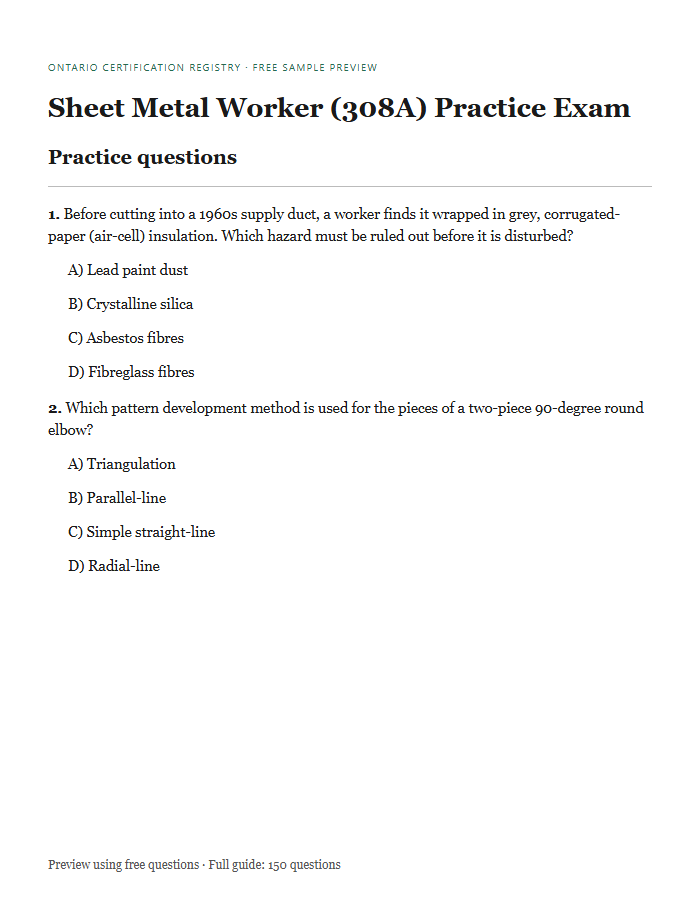
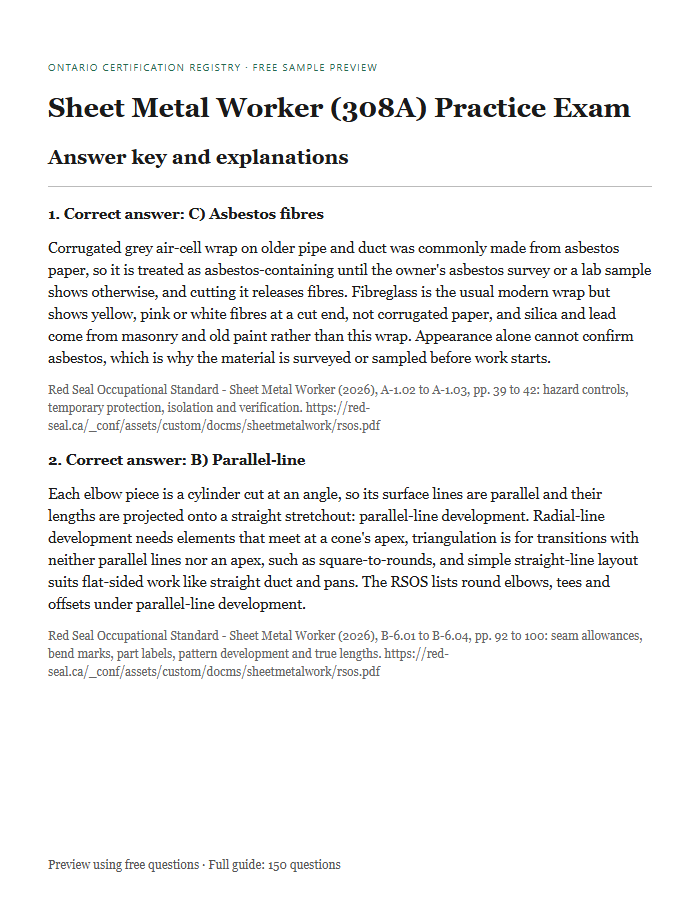
Look inside the PDF
A preview of the question and answer-key layout, using questions from the free sample. The full guide contains all 150 questions.
What this guide covers
The published Red Seal exam-information page lists a 120-question paper and MWA counts A-E of 24/38/41/10/7. Scaled by 1.25, the exact counts are 30/47.5/51.25/12.5/8.75. Whole-question allocation is 30/48/51/12/9: the tied half-question is assigned to B rather than D, and E receives the remaining fractional allocation. The 2026 RSOS overview says exams based on that RSOS are currently under development. Therefore these activity counts and cognitive ranges describe the published exam page, while the technical references use the current 2026 RSOS task numbering. This is an editorial practice bank, not an official blueprint for the new RSOS. The table shows the actual counts and shares in this guide.
| Major work activity | Questions here | Share of this guide |
|---|---|---|
| A. Performs common occupational skills | 30 | 20% |
| B. Performs fabrication | 48 | 32% |
| C. Installs air and material handling systems | 51 | 34% |
| D. Installs roofing and specialty products | 12 | 8% |
| E. Performs maintenance and repair | 9 | 6% |
The published official exam has 120 questions. This guide contains 150 original study questions, with topic counts rounded to fit that length.
Coverage source: Published Red Seal exam breakdown
The mix of question types
The table compares this guide's mix with the published Red Seal ranges for this trade.
| Type | Questions here | Share | Published range |
|---|---|---|---|
| Knowledge and recall | 38 | 25.3% | 20 to 30% |
| Procedural and application | 102 | 68% | 60 to 70% |
| Critical thinking | 10 | 6.7% | 5 to 15% |
30 free sample questions from the Sheet Metal Worker (308A) bank
This fixed selection comes straight from the bank and covers every major work activity, with the answers and sources shown. Read them before you decide whether the rest is worth $67.49 to you.
Question 1: Before cutting into a 1960s supply duct, a worker finds it wrapped in grey, corrugated-paper (air-cell) insulation. Which hazard must be ruled out before it is disturbed?
Sample 1 · Activity A
Before cutting into a 1960s supply duct, a worker finds it wrapped in grey, corrugated-paper (air-cell) insulation. Which hazard must be ruled out before it is disturbed?
- Lead paint dust
- Crystalline silica
- Asbestos fibres (correct)
- Fibreglass fibres
Corrugated grey air-cell wrap on older pipe and duct was commonly made from asbestos paper, so it is treated as asbestos-containing until the owner's asbestos survey or a lab sample shows otherwise, and cutting it releases fibres. Fibreglass is the usual modern wrap but shows yellow, pink or white fibres at a cut end, not corrugated paper, and silica and lead come from masonry and old paint rather than this wrap. Appearance alone cannot confirm asbestos, which is why the material is surveyed or sampled before work starts.
Red Seal Occupational Standard - Sheet Metal Worker (2026), A-1.02 to A-1.03, pp. 39 to 42: hazard controls, temporary protection, isolation and verification. https://red-seal.ca/_conf/assets/custom/docms/sheetmetalwork/rsos.pdf
Question 2: A worker gets solvent-based duct sealant on the skin of a forearm. Which section of the product's WHMIS safety data sheet gives the first-aid steps for skin contact?
Sample 2 · Activity A
A worker gets solvent-based duct sealant on the skin of a forearm. Which section of the product's WHMIS safety data sheet gives the first-aid steps for skin contact?
- SDS section 4 (correct)
- SDS section 11
- SDS section 2
- SDS section 8
Section 4, First-aid measures, sets out first aid by route of exposure (inhalation, skin, eye, ingestion), the main symptoms and whether immediate medical attention is needed. Section 2 summarizes the hazards and label precautionary statements, section 8 gives exposure limits, engineering controls and PPE, and section 11 describes toxic effects by route without the treatment steps. Reading the SDS before use means the response is known before a splash happens.
CCOHS, WHMIS - Safety Data Sheets (SDSs), standardized sections including first-aid measures and exposure controls. https://www.ccohs.ca/oshanswers/chemicals/whmis_ghs/sds.html
Question 3: While a hanger rod is cut with an abrasive cut-off saw, sparks are landing on a pile of oily rags 3 m away. What should be done first?
Sample 3 · Activity A
While a hanger rod is cut with an abrasive cut-off saw, sparks are landing on a pile of oily rags 3 m away. What should be done first?
- Post a fire watch, continue
- Keep an extinguisher handy
- Angle the sparks away
- Stop cutting, remove the rags (correct)
The ignition source has already reached the fuel, so cutting stops until the rags are removed, ideally into a closed metal container, and the area is checked for smouldering. An extinguisher and a fire watch are back-ups for the risk that remains, not a substitute for separating sparks from combustibles. Sparks bounce and travel well beyond where the wheel is aimed, so turning the saw does not make the rags safe.
Red Seal Occupational Standard - Sheet Metal Worker (2026), A-1.02 to A-1.03, pp. 39 to 42: hazard controls, temporary protection, isolation and verification. https://red-seal.ca/_conf/assets/custom/docms/sheetmetalwork/rsos.pdf
Question 4: A 125 mm cut-off disc's only legible speed marking is 80 m/s. To the nearest 100 rpm, what is the highest spindle speed it may run at?
Sample 4 · Activity A
A 125 mm cut-off disc's only legible speed marking is 80 m/s. To the nearest 100 rpm, what is the highest spindle speed it may run at?
- 24,400 rpm
- 38,400 rpm
- 12,200 rpm (correct)
- 6,100 rpm
Speed = 80 m/s x 60 / (π x 0.125 m) = 4,800 / 0.3927 = 12,223 rpm, or 12,200 rpm, and the grinder's nameplate speed must not exceed it: an 11,000 rpm grinder is acceptable, a 13,300 rpm one is not. 24,400 uses the radius in place of the diameter, 38,400 leaves out π, and 6,100 uses 2π x diameter. If the disc's printed rpm is legible, that marking governs.
CCOHS, Abrasive Wheels - Wheel Mounting on Portable Grinders and Use of Bench and Pedestal Grinders. Compare grinder speed with the marked wheel speed; do not exceed the wheel rating. https://www.ccohs.ca/oshanswers/safety_haz/abrasive_wheels/mounting.html ; https://www.ccohs.ca/oshanswers/safety_haz/abrasive_wheels/safeuse2.html
Question 5: A takeoff lists 14 m of 500 x 300 mm rectangular duct. Before seam and waste allowances, how much sheet area does it need?
Sample 5 · Activity A
A takeoff lists 14 m of 500 x 300 mm rectangular duct. Before seam and waste allowances, how much sheet area does it need?
- 11.2 m²
- 22.4 m² (correct)
- 44.8 m²
- 2.1 m²
The girth is 2 x (0.5 + 0.3) = 1.6 m, and 1.6 x 14 = 22.4 m² of sheet. 11.2 m² counts only one side and one top, 2.1 is the cross-section area times the length (a volume in m³, not sheet), and 44.8 m² doubles the girth. Seam, lock and waste allowances are then added to the shop's standards when sheets are ordered.
Red Seal Occupational Standard - Sheet Metal Worker (2026), A-3.02 to A-3.04, pp. 76 to 81: dimensions, coordination, inventory and approved modifications. https://red-seal.ca/_conf/assets/custom/docms/sheetmetalwork/rsos.pdf
Question 6: A journeyperson explains a brake set-up to an apprentice. Which practice best confirms the apprentice understood?
Sample 6 · Activity A
A journeyperson explains a brake set-up to an apprentice. Which practice best confirms the apprentice understood?
- Ask if they understood it
- Repeat the steps a second time
- Have them explain it back (correct)
- Hand them the brake manual
The RSOS calls for understanding to be confirmed by both parties and lists paraphrasing under active listening, so asking the apprentice to explain the set-up in their own words shows what was actually received. A yes-or-no question usually gets a yes whatever was understood, and repeating the steps or handing over the manual sends the message again without checking it. Watching the apprentice do the set-up under supervision confirms it further.
Red Seal Occupational Standard - Sheet Metal Worker, 2026 edition, current Task A-5, Uses communication and mentoring techniques: performance criteria and knowledge requirements. https://red-seal.ca/_conf/assets/custom/docms/sheetmetalwork/rsos.pdf
Question 7: Which pattern development method is used for the pieces of a two-piece 90-degree round elbow?
Sample 7 · Activity B
Which pattern development method is used for the pieces of a two-piece 90-degree round elbow?
- Triangulation
- Parallel-line (correct)
- Simple straight-line
- Radial-line
Each elbow piece is a cylinder cut at an angle, so its surface lines are parallel and their lengths are projected onto a straight stretchout: parallel-line development. Radial-line development needs elements that meet at a cone's apex, triangulation is for transitions with neither parallel lines nor an apex, such as square-to-rounds, and simple straight-line layout suits flat-sided work like straight duct and pans. The RSOS lists round elbows, tees and offsets under parallel-line development.
Red Seal Occupational Standard - Sheet Metal Worker (2026), B-6.01 to B-6.04, pp. 92 to 100: seam allowances, bend marks, part labels, pattern development and true lengths. https://red-seal.ca/_conf/assets/custom/docms/sheetmetalwork/rsos.pdf
Question 8: What is the purpose of cross-breaking a large flat panel of rectangular duct?
Sample 8 · Activity B
What is the purpose of cross-breaking a large flat panel of rectangular duct?
- Allow for thermal expansion
- Stiffen it against drumming (correct)
- Drain condensate to one side
- Reduce the panel's air leakage
The RSOS says pieces are cross-broken or beaded to strengthen them and eliminate vibration and noise: the shallow X-shaped fold stops a flat panel oil-canning and drumming as pressure changes. Cross-breaking does not seal anything, since leakage depends on seams, joints and sealant, and it is not an expansion joint or a drain. It does not replace any reinforcement the duct construction standard requires.
Red Seal Occupational Standard - Sheet Metal Worker (2026), B-7.02 to B-7.06, pp. 104 to 110 and following: panel forming/stiffening, liners, assembly, dampers and supports. https://red-seal.ca/_conf/assets/custom/docms/sheetmetalwork/rsos.pdf
Question 9: Using mitre angle = angle of elbow / (2 x number of gores - 2), what mitre angle does a 90-degree, five-gore elbow need?
Sample 9 · Activity B
Using mitre angle = angle of elbow / (2 x number of gores - 2), what mitre angle does a 90-degree, five-gore elbow need?
- 22.5 degrees
- 9 degrees
- 18 degrees
- 11.25 degrees (correct)
90 / (2 x 5 - 2) = 90 / 8 = 11.25 degrees. The two end gores are half gores, so a five-gore elbow is made of eight half-gore turns, which is why the divisor is 2N - 2. 18 degrees divides by the number of gores, 22.5 by gores minus one, and 9 by twice the gores.
Red Seal Sheet Metal Worker: Mathematical Formulas, pp. 1 to 3. The question states its dimensions and formula conventions. https://red-seal.ca/_conf/assets/custom/docms/sheetmetalwork/formulas.pdf
Question 10: Using bend allowance = degrees x (0.01743R + 0.0078t), what is the allowance for a 90-degree bend with a 0.25 in inside radius in 0.060 in sheet?
Sample 10 · Activity B
Using bend allowance = degrees x (0.01743R + 0.0078t), what is the allowance for a 90-degree bend with a 0.25 in inside radius in 0.060 in sheet?
- 0.434 in (correct)
- 0.826 in
- 0.270 in
- 0.392 in
90 x (0.01743 x 0.25 + 0.0078 x 0.060) = 90 x (0.0043575 + 0.000468) = 90 x 0.0048255 = 0.434 in. 0.392 in drops the thickness term, 0.826 in uses the 0.5 in diameter as R, and 0.270 in swaps R and t between the two constants. Round only the final answer, as the formula sheet directs.
Red Seal Sheet Metal Worker: Mathematical Formulas, pp. 1 to 3. The question states its dimensions and formula conventions. https://red-seal.ca/_conf/assets/custom/docms/sheetmetalwork/formulas.pdf
Question 11: A reducer has a large diameter of 18 in, a small diameter of 10 in and a vertical height of 16 in. Using apex height = large diameter x vertical height / (large diameter - small diameter), what is the apex height above the large base?
Sample 11 · Activity B
A reducer has a large diameter of 18 in, a small diameter of 10 in and a vertical height of 16 in. Using apex height = large diameter x vertical height / (large diameter - small diameter), what is the apex height above the large base?
- 36 in (correct)
- 28.8 in
- 20 in
- 10.29 in
18 x 16 / (18 - 10) = 288 / 8 = 36 in. 20 in is the apex height above the small end (10 x 16 / 8, or 36 - 16), 28.8 in divides by the small diameter, and 10.29 in divides by the sum of the diameters. Pattern radii are slant lengths, found from this apex height and the base radius with the Pythagorean theorem.
Red Seal Sheet Metal Worker: Mathematical Formulas, pp. 1 to 3. The question states its dimensions and formula conventions. https://red-seal.ca/_conf/assets/custom/docms/sheetmetalwork/formulas.pdf
Question 12: A single-blade volume damper is to fit inside a 400 x 250 mm duct. The shop detail allows 3 mm clearance at every edge of the blade. What size is the blade cut?
Sample 12 · Activity B
A single-blade volume damper is to fit inside a 400 x 250 mm duct. The shop detail allows 3 mm clearance at every edge of the blade. What size is the blade cut?
- 388 x 238 mm
- 406 x 256 mm
- 394 x 244 mm (correct)
- 397 x 247 mm
Clearance at every edge comes off both sides of each dimension: 400 - 2 x 3 = 394 mm and 250 - 2 x 3 = 244 mm. Taking 3 mm off each dimension only once gives 397 x 247 mm, leaving 1.5 mm per edge and a blade likely to bind. The 3 mm figure is this detail's value; cycle the blade after assembly to confirm it swings freely.
Red Seal Occupational Standard - Sheet Metal Worker (2026), B-7.02 to B-7.06, pp. 104 to 110 and following: panel forming/stiffening, liners, assembly, dampers and supports. https://red-seal.ca/_conf/assets/custom/docms/sheetmetalwork/rsos.pdf
Question 13: Two 600 x 300 mm duct sections are joined with S-cleats on the long sides and drive cleats on the short sides. Each drive is cut 25 mm longer at each end so it can be folded over. What is the cut list?
Sample 13 · Activity B
Two 600 x 300 mm duct sections are joined with S-cleats on the long sides and drive cleats on the short sides. Each drive is cut 25 mm longer at each end so it can be folded over. What is the cut list?
- S 600 mm, drives 325 mm
- S 600 mm, drives 300 mm
- S 600 mm, drives 350 mm (correct)
- S 650 mm, drives 350 mm
The S-cleats run the 600 mm sides at their actual length, and each drive is the 300 mm side plus 25 mm at each end: 300 + 2 x 25 = 350 mm. Drives cut to the bare 300 mm leave nothing to fold over the S-cleat ends, so the S-cleats can slide out. The S-cleats need no fold allowance; only the drives, fitted last, are bent over to lock the joint.
Red Seal Occupational Standard - Sheet Metal Worker (2026), B-7.02 to B-7.06, pp. 104 to 110 and following: panel forming/stiffening, liners, assembly, dampers and supports. https://red-seal.ca/_conf/assets/custom/docms/sheetmetalwork/rsos.pdf
Question 14: A flashing for a vertical 150 mm round pipe sits on a roof sloped at 30 degrees. How long must its opening be, measured up the slope?
Sample 14 · Activity B
A flashing for a vertical 150 mm round pipe sits on a roof sloped at 30 degrees. How long must its opening be, measured up the slope?
- 300 mm
- 130 mm
- 173 mm (correct)
- 150 mm
A vertical pipe cuts a sloped sheet in an ellipse: across the slope the opening stays 150 mm, but up the slope it stretches to 150 / cos 30 = 150 / 0.866 = 173 mm. Multiplying by the cosine (130 mm) shrinks the hole instead, and 150 / sin 30 (300 mm) uses the wrong ratio. Add any collar or clearance the detail calls for to these figures.
Red Seal Occupational Standard - Sheet Metal Worker, 2026 edition, current Task B-8, Fabricates flashing, roofing, sheeting and cladding; performance criteria and knowledge requirements. https://red-seal.ca/_conf/assets/custom/docms/sheetmetalwork/rsos.pdf
Question 15: A 9 m run of aluminum coping is installed at 10 °C and will range from -30 °C to 70 °C in service. Aluminum expands 0.000023 mm per mm per °C. How much longer is the run at 70 °C than when installed?
Sample 15 · Activity B
A 9 m run of aluminum coping is installed at 10 °C and will range from -30 °C to 70 °C in service. Aluminum expands 0.000023 mm per mm per °C. How much longer is the run at 70 °C than when installed?
- 12.4 mm (correct)
- 20.7 mm
- 8.3 mm
- 14.5 mm
The rise from 10 °C to 70 °C is 60 °C, so 9,000 x 0.000023 x 60 = 12.4 mm. Using the full -30 to 70 °C range (20.7 mm) adds the contraction side, which the joint must also absorb but in the other direction (8.3 mm shorter at -30 °C). This movement is why expansion joints and sliding clips must not be screwed solid.
Red Seal Occupational Standard - Sheet Metal Worker, 2026 edition, current Task B-8, Fabricates flashing, roofing, sheeting and cladding; performance criteria and knowledge requirements. https://red-seal.ca/_conf/assets/custom/docms/sheetmetalwork/rsos.pdf
Question 16: A guard drawing gives mounting-hole centres of 516 mm ± 1 mm. Four guards measure 515.5, 517.0, 517.5 and 516.0 mm. How many are within tolerance?
Sample 16 · Activity B
A guard drawing gives mounting-hole centres of 516 mm ± 1 mm. Four guards measure 515.5, 517.0, 517.5 and 516.0 mm. How many are within tolerance?
- Two of the four
- All four of them
- One of the four
- Three of the four (correct)
The tolerance band is 515.0 to 517.0 mm inclusive, so 515.5, 517.0 and 516.0 mm pass and 517.5 mm fails by 0.5 mm. Treating 517.0 mm as a failure (two pass) misreads a limit value, and rounding 517.5 mm down (all four) hides a real error. The 517.5 mm guard needs correction or rejection before assembly.
Red Seal Occupational Standard - Sheet Metal Worker, 2026 edition, current Task B-9, Fabricates specialty products; performance criteria and knowledge requirements. https://red-seal.ca/_conf/assets/custom/docms/sheetmetalwork/rsos.pdf
Question 17: Hanger inserts must sit directly above duct centreline marks snapped on the floor. Which tool transfers those marks up to the deck?
Sample 17 · Activity C
Hanger inserts must sit directly above duct centreline marks snapped on the floor. Which tool transfers those marks up to the deck?
- A chalk line and square
- A plumb laser or plumb bob (correct)
- A builder's level and rod
- A water level and tape
A plumb bob or plumb laser gives a true vertical, so a floor point can be carried straight up to the deck for the insert or anchor. A builder's level or water level transfers heights, not plan positions, and a chalk line and square only lay out lines on one surface. Check the deck for embedded services before drilling.
Red Seal Occupational Standard - Sheet Metal Worker, 2026 edition, current Task C-10, Prepares installation site; performance criteria and knowledge requirements. https://red-seal.ca/_conf/assets/custom/docms/sheetmetalwork/rsos.pdf
Question 18: Why is an opposed-blade damper usually chosen over a parallel-blade damper for volume control near a branch or outlet?
Sample 18 · Activity C
Why is an opposed-blade damper usually chosen over a parallel-blade damper for volume control near a branch or outlet?
- Tighter shut-off when closed
- More even flow when throttled (correct)
- Lower loss when wide open
- Closes on its own in a fire
As opposed blades close they throttle without turning the airstream, so flow stays evenly spread just downstream. Parallel blades all tilt the same way and pile the air up on one side of the duct, which upsets branches located close to the damper. Shut-off tightness depends on blade and edge seals, and closing on fire is a fire damper's job.
Red Seal Occupational Standard - Sheet Metal Worker, 2026 edition, current Task C-12, Installs air handling system components; performance criteria and knowledge requirements. https://red-seal.ca/_conf/assets/custom/docms/sheetmetalwork/rsos.pdf Also: Aerovent, FE-2600 Fan Damper Selection, Outlet Control Dampers, p. 2. https://aerovent.com/wp-content/uploads/2018/12/Fan-Damper-Selection-FE-2600.pdf
Question 19: The drawing locates the centre of a 300 mm wide duct 600 mm from a wall. The duct is wrapped with 25 mm insulation. How far is the insulation face from the wall?
Sample 19 · Activity C
The drawing locates the centre of a 300 mm wide duct 600 mm from a wall. The duct is wrapped with 25 mm insulation. How far is the insulation face from the wall?
- 450 mm
- 425 mm (correct)
- 575 mm
- 400 mm
Half the duct width is 150 mm and the insulation adds 25 mm on that side: 600 - 150 - 25 = 425 mm. Stopping at the metal (450 mm) overstates the clearance by the insulation thickness, and 400 mm counts the insulation twice. Check that 425 mm still gives any access or clearance the drawings require.
Red Seal Occupational Standard - Sheet Metal Worker, 2026 edition, current Task C-10, Prepares installation site; performance criteria and knowledge requirements. https://red-seal.ca/_conf/assets/custom/docms/sheetmetalwork/rsos.pdf
Question 20: An approved vent schedule allows 9 m equivalent length. The route has 5 m of straight pipe and three elbows, each counted as 1.5 m. How does the route compare with the limit?
Sample 20 · Activity C
An approved vent schedule allows 9 m equivalent length. The route has 5 m of straight pipe and three elbows, each counted as 1.5 m. How does the route compare with the limit?
- 9.5 m, 0.5 m over (correct)
- 5.0 m, 4.0 m under
- 6.5 m, 2.5 m under
- 8.0 m, 1.0 m under
Equivalent length adds the straight pipe and each fitting's allowance: 5 + 3 x 1.5 = 9.5 m, which is 0.5 m over the 9 m limit. Counting the elbow allowance once (6.5 m) or ignoring fittings (5.0 m) makes an unacceptable route look acceptable. Shorten the route, remove a fitting or use a size the schedule allows.
Red Seal Occupational Standard - Sheet Metal Worker, 2026 edition, current Task C-11, Installs and connects chimneys, breeching and venting to exhaust appliances and mechanical equipment; performance criteria and knowledge requirements. Equipment-specific clearances and routes remain subject to approved design, applicable code and exact manufacturer instructions. https://red-seal.ca/_conf/assets/custom/docms/sheetmetalwork/rsos.pdf
Question 21: At fan-drive commissioning, a straightedge is held against both rims of the motor sheave. Both sheaves have been checked to run true. It touches only the near rim of the fan sheave, leaving a 3 mm gap at the far rim. Which alignment correction is needed?
Sample 21 · Activity C
At fan-drive commissioning, a straightedge is held against both rims of the motor sheave. Both sheaves have been checked to run true. It touches only the near rim of the fan sheave, leaving a 3 mm gap at the far rim. Which alignment correction is needed?
- Make the shafts parallel (correct)
- Fit a shorter matched belt set
- Increase the belt tension
- Shift a sheave along its shaft
Different gaps at the two rims show angular misalignment, so correct shaft parallelism. An axial sheave offset would leave the same gap at both rims, while belt tension and length cannot align the sheave faces. Recheck both angular and offset alignment before tensioning the belts.
Red Seal Occupational Standard - Sheet Metal Worker, 2026 edition, current Task C-12, Installs air handling system components; performance criteria and knowledge requirements. https://red-seal.ca/_conf/assets/custom/docms/sheetmetalwork/rsos.pdf
Question 22: A filter bank must pass 7,200 cfm at no more than 500 fpm face velocity. It uses 24 x 24 in filters, counted at their nominal face area. What is the minimum number of filters?
Sample 22 · Activity C
A filter bank must pass 7,200 cfm at no more than 500 fpm face velocity. It uses 24 x 24 in filters, counted at their nominal face area. What is the minimum number of filters?
- 15 filters
- 8 filters
- 4 filters (correct)
- 3 filters
Required face area = 7,200 / 500 = 14.4 sq ft. Each 24 x 24 in filter is 576 / 144 = 4 sq ft, so 14.4 / 4 = 3.6, rounded up to 4. Rounding down to 3 gives 12 sq ft and 600 fpm, over the limit, and 15 is the area in square feet rather than a filter count.
Red Seal Occupational Standard - Sheet Metal Worker, 2026 edition, current Task C-12, Installs air handling system components; performance criteria and knowledge requirements. https://red-seal.ca/_conf/assets/custom/docms/sheetmetalwork/rsos.pdf
Question 23: A 6 in round branch in a wood-dust system must keep a conveying velocity of at least 4,000 fpm, as stated in the design. What minimum airflow does that branch need?
Sample 23 · Activity C
A 6 in round branch in a wood-dust system must keep a conveying velocity of at least 4,000 fpm, as stated in the design. What minimum airflow does that branch need?
- 3,142 cfm
- 785 cfm (correct)
- 1,131 cfm
- 6,283 cfm
Area = π r² = π x (3 / 12)² = 0.196 sq ft, and 0.196 x 4,000 = 785 cfm. Treating 6 in as the radius gives 3,142 cfm, using π x diameter (a circumference) gives 6,283, and reading 6 in as 0.6 ft gives 1,131. Below the design velocity, dust drops out in horizontal runs and can plug the branch.
Red Seal Occupational Standard - Sheet Metal Worker, 2026 edition, current Task C-13, Installs material handling system components; performance criteria and knowledge requirements. https://red-seal.ca/_conf/assets/custom/docms/sheetmetalwork/rsos.pdf
Question 24: Aluminum jacketing is cut for insulation with a 300 mm outside diameter and a 50 mm longitudinal overlap. Ignoring sheet thickness, what cut width is needed to the nearest millimetre?
Sample 24 · Activity C
Aluminum jacketing is cut for insulation with a 300 mm outside diameter and a 50 mm longitudinal overlap. Ignoring sheet thickness, what cut width is needed to the nearest millimetre?
- 992 mm (correct)
- 1,042 mm
- 521 mm
- 942 mm
The circumference is π x 300 = 942.48 mm; adding the single 50 mm lap gives 992.48 mm, which rounds to 992 mm. The 942 mm choice omits the lap, 1,042 mm adds it twice, and 521 mm uses the radius instead of the diameter. Measure the actual insulated diameter before cutting, since it can differ from nominal.
Red Seal Occupational Standard - Sheet Metal Worker (2026), C-14.01 to C-14.03: insulation and coverings; C-14.02.06P and C-14.03.04P: weather-shedding seams and joints. https://red-seal.ca/_conf/assets/custom/docms/sheetmetalwork/rsos.pdf
Question 25: A 24 x 12 in return grille has 70% free area. The averaged velocity reading is 450 fpm. Using the formula sheet's grille measurement formula, what is the airflow?
Sample 25 · Activity C
A 24 x 12 in return grille has 70% free area. The averaged velocity reading is 450 fpm. Using the formula sheet's grille measurement formula, what is the airflow?
- 270 cfm
- 630 cfm (correct)
- 1,286 cfm
- 900 cfm
Area = 24 x 12 / 144 = 2 sq ft, and cfm = 2 x 70 / 100 x 450 = 630 cfm. Leaving out the free-area factor gives 900 cfm, dividing by it gives 1,286, and using the blocked 30% gives 270. Where the grille maker publishes its own area factor for the instrument used, that procedure replaces this one.
Red Seal Sheet Metal Worker: Mathematical Formulas, pp. 1 to 3. The question states its dimensions and formula conventions. https://red-seal.ca/_conf/assets/custom/docms/sheetmetalwork/formulas.pdf
Question 26: A pitot traverse in a long straight section of a branch reads 1,200 cfm. A capture hood at the four diffusers on that branch totals 960 cfm. Both instruments are in calibration. What best explains the difference?
Sample 26 · Activity C
A pitot traverse in a long straight section of a branch reads 1,200 cfm. A capture hood at the four diffusers on that branch totals 960 cfm. Both instruments are in calibration. What best explains the difference?
- Supply fan speed too low
- Undersized diffuser necks
- Leakage in the branch duct (correct)
- Diffuser dampers too closed
The traverse and the hood measure the same air in series, so the missing 240 cfm (20%) is escaping from the duct between them through seams, joints or open connections. A slow fan, throttled dampers or small necks would lower both readings together, not open a gap between them. Seal and retest that section before balancing, or the outlets get set against air that never reaches them.
Red Seal Occupational Standard - Sheet Metal Worker, 2026 edition, current Task C-15, Performs leak testing, air balancing and commissioning; performance criteria and knowledge requirements. Use only scenario-specified criteria and instrument readings, not invented code acceptance values. https://red-seal.ca/_conf/assets/custom/docms/sheetmetalwork/rsos.pdf
Question 27: Exposed-fastener metal roof panels are being laid. At which end of the roof should installation start so the side laps resist wind-driven rain?
Sample 27 · Activity D
Exposed-fastener metal roof panels are being laid. At which end of the roof should installation start so the side laps resist wind-driven rain?
- Upwind, facing prevailing wind
- Nearest the hoisting point
- Centre of roof, working out
- Downwind of prevailing wind (correct)
Starting at the downwind end and working toward the prevailing wind leaves every side lap with its exposed edge facing away from the wind, so rain blows over the laps instead of under them. Starting upwind reverses every lap, and starting at the centre reverses the laps on one half of the roof. The roofing maker's instructions for the actual profile still govern.
Red Seal Occupational Standard - Sheet Metal Worker, 2026 edition, current Task D-16, Installs roofing and cladding systems; performance criteria and knowledge requirements. https://red-seal.ca/_conf/assets/custom/docms/sheetmetalwork/rsos.pdf Also: Damus Roofing Systems, Installation Guide: Roof Sheeting, step 6: start panels at the roof edge downwind or away from the prevailing wind so wind, rain and snow blow over, not under, the side lap seams. https://www.mydamus.com/wp-content/uploads/2023/03/Damus-Roofing-Systems-Installation-Sheeting-2.pdf
Question 28: A 240 kg stainless kitchen exhaust hood hangs from six threaded rods sharing the load equally. The specification requires each rod and anchor to have 4 times its load in capacity. What minimum capacity is needed per rod?
Sample 28 · Activity D
A 240 kg stainless kitchen exhaust hood hangs from six threaded rods sharing the load equally. The specification requires each rod and anchor to have 4 times its load in capacity. What minimum capacity is needed per rod?
- 240 kg
- 960 kg
- 160 kg (correct)
- 40 kg
Each rod carries 240 / 6 = 40 kg, and the factor of 4 gives 40 x 4 = 160 kg per rod and anchor. 40 kg leaves no margin, 960 kg applies the factor to the whole hood, and 240 kg is the whole hood's weight. Equal sharing assumes the rods are adjusted evenly; a slack rod throws its share onto its neighbours.
Red Seal Occupational Standard - Sheet Metal Worker, 2026 edition, current Task D-18, Installs specialty products; performance criteria and knowledge requirements. https://red-seal.ca/_conf/assets/custom/docms/sheetmetalwork/rsos.pdf
Question 29: A new matched set of V-belts has been fitted and tensioned on a supply fan. When should the belt tension be rechecked?
Sample 29 · Activity E
A new matched set of V-belts has been fitted and tensioned on a supply fan. When should the belt tension be rechecked?
- At the next annual service
- After about 24 h running (correct)
- After 1,000 h of running
- When the belts start to squeal
New belts stretch and seat into the sheave grooves in their first hours, so tension drops; the usual practice is to readjust after about 24 hours of operation using the maker's retension values. Waiting for the annual service or 1,000 hours lets the belts run slack and slip, and squealing means slipping has already started.
Red Seal Occupational Standard - Sheet Metal Worker, 2026 edition, current Task E-19, Performs scheduled maintenance; performance criteria and knowledge requirements. https://red-seal.ca/_conf/assets/custom/docms/sheetmetalwork/rsos.pdf Also: T. Bishop, Reliable V-Belt Drive Operation, ACHR News, 2017-06-02: new belts stretch, so readjust tension after about 24 hours of operation. https://achrnews.com/articles/158972-reliable-v-belt-drive-operation
Question 30: Since a renovation, a forward-curved supply fan's motor trips on overload. At unchanged rpm, airflow is above and static pressure below the last balancing report. What is the most likely cause?
Sample 30 · Activity E
Since a renovation, a forward-curved supply fan's motor trips on overload. At unchanged rpm, airflow is above and static pressure below the last balancing report. What is the most likely cause?
- Slipping drive belt
- Fan wheel reversed
- Clogged filter bank
- Reduced system resistance (correct)
A forward-curved fan's power rises steeply with airflow, so when resistance drops (duct left open or removed, a missing access panel, dampers opened wide) it moves more air at lower pressure and overloads its motor. A clogged filter raises resistance and lowers airflow and amps, a slipping belt lowers rpm, and a reversed wheel cuts airflow. Find and correct the change in the duct system, or lower fan speed, rather than fitting a larger motor.
Red Seal Occupational Standard - Sheet Metal Worker, 2026 edition, current Task E-20, Repairs faulty systems and components; performance criteria and knowledge requirements. https://red-seal.ca/_conf/assets/custom/docms/sheetmetalwork/rsos.pdf Also: AMCA International, Troubleshooting Problems in Fan Systems (R. Wroblewski, ASET-US Conference, March 2018), Motor Failure causes slide: power spike from higher than anticipated airflow, especially forward curved fans. https://www.amca.org/resources/Wroblewski%20ASET-US-2018(1).pdf
Before you buy
- These questions use the cited occupational standards, curriculum and technical references. Nothing here is reproduced from a real exam.
- Passing this does not guarantee passing the certifying exam, and nothing here is a substitute for the training standard or your in-school hours.
- It is a PDF. There is no login, no expiry and no subscription, and you can print it.
- Automated structure and distribution checks are complete. Technical accuracy review by a licensed tradesperson remains outstanding.
Questions about your purchase or a missing PDF? Contact Blue Crane Works with the email used at checkout. The download link lasts 30 days; your saved PDF does not expire.
When you are ready for the real exam
You book the 308A certifying exam yourself in the Skilled Trades Ontario Portal ($150 plus HST) and write it at one of 24 exam centres, or at your college in your final level of school. How to book it and find the nearest centre.
Writing in Alberta, BC or Manitoba? Same Red Seal exam
The Sheet Metal Worker exam is the national Red Seal exam, so this practice exam fits writers in other provinces too, wherever the trade carries the Red Seal. Trade names differ by province.
Where the exam facts on this page come from
The published Red Seal exam-information page lists a 120-question paper and MWA counts A-E of 24/38/41/10/7. Scaled by 1.25, the exact counts are 30/47.5/51.25/12.5/8.75. Whole-question allocation is 30/48/51/12/9: the tied half-question is assigned to B rather than D, and E receives the remaining fractional allocation. The 2026 RSOS overview says exams based on that RSOS are currently under development. Therefore these activity counts and cognitive ranges describe the published exam page, while the technical references use the current 2026 RSOS task numbering. This is an editorial practice bank, not an official blueprint for the new RSOS. The regulation and issuing authority explain the actual credential and examination requirements.
The free reference material for this trade
Everything about the certification itself, the classification, the hours, the ratio and the official sources, stays free on this site and always will. The practice exam is the only thing here that costs anything.
Other practice exams
 309AConstruction Electrician
 G.2Gas Technician 2
 306APlumber
 433AIndustrial Mechanic Millwright
 310SAutomotive Service Technician
 G.3Gas Technician 3
 310TTruck and Coach Technician
 332AHairstylist
 442AIndustrial Electrician
 415ACook
 456AWelder
 429AGeneral Machinist
 339AMobile Crane Operator
 339BTower Crane Operator