Free practice test
Try 30 questions free
Work through 30 questions, then see your score, results by topic and an explanation for every answer. No account or email needed.
These are 30 of the 150 questions in the full PDF. You can also read the questions and answers below.
The full 150-question PDF
Includes the 30 free questions plus 120 additional questions, explanations and references. One payment, no subscription.
| Questions | 150, all original |
|---|---|
| Answer key | Correct answer, the reasoning, and a cited source for each question |
| Distinct references | 68 distinct citations across the bank |
| Free samples here | 30, with answers, below |
| Format | PDF, emailed on purchase, plus a download link valid 30 days |
| Price | $67.49 CAD, one payment, no subscription |
Payment is handled by Stripe. This is study material, not an official exam, and it is not affiliated with Skilled Trades Ontario, TSSA or the Red Seal program.
Look inside the PDF
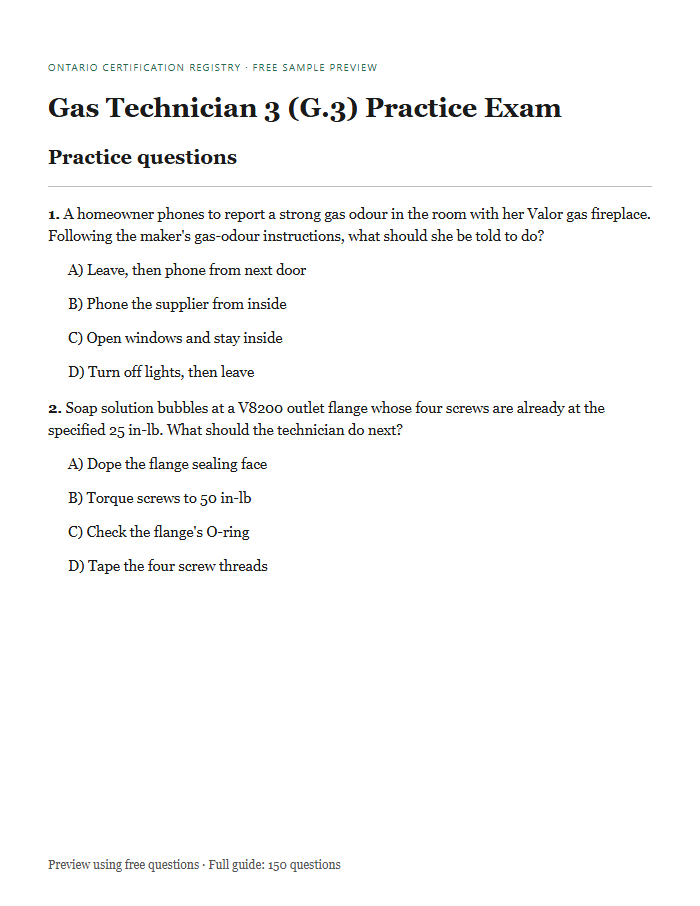
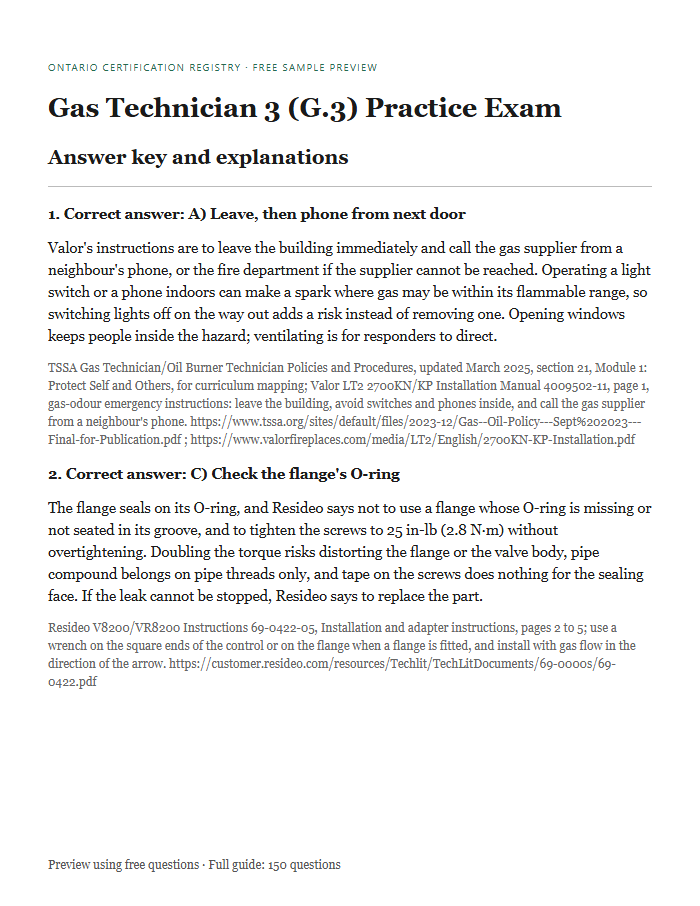
A preview of the question and answer-key layout, using questions from the free sample. The full guide contains all 150 questions.
What this guide covers
Editorial foundation review with equal target counts across the nine TSSA G.3 curriculum modules. TSSA's current policy lists the modules but does not publish an exam question count, topic weighting or cognitive-level weighting. The counts and mix in this guide are not official TSSA exam specifications. The table shows the actual counts and shares in this guide.
| Major work activity | Questions here | Share of this guide |
|---|---|---|
| A. TSSA G.3 Module 1: Protect Self and Others | 17 | 11.3% |
| B. TSSA G.3 Module 2: Fasteners, Hand Tools and Power Tools | 17 | 11.3% |
| C. TSSA G.3 Module 3: Properties, Characteristics and Safe Handling of Fuel Gases | 17 | 11.3% |
| D. TSSA G.3 Module 4: Installation Codes, Acts and Regulations | 17 | 11.3% |
| E. TSSA G.3 Module 5: Introduction to Electricity | 17 | 11.3% |
| F. TSSA G.3 Module 6: Manuals, Specifications, Schematics, Drawings and Graphs | 17 | 11.3% |
| G. TSSA G.3 Module 7: Customer Relations | 16 | 10.7% |
| H. TSSA G.3 Module 8: Introduction to Piping and Tubing Systems | 16 | 10.7% |
| I. TSSA G.3 Module 9: Introduction to Gas Appliances | 16 | 10.7% |
Coverage source: TSSA training curriculum and certification policy
The mix of question types
This is our editorial study mix, not an official examination distribution.
| Type | Questions here | Share |
|---|---|---|
| Knowledge and recall | 26 | 17.3% |
| Procedural and application | 99 | 66% |
| Critical thinking | 25 | 16.7% |
30 free sample questions from the Gas Technician 3 (G.3) bank
This fixed selection comes straight from the bank and covers every major work activity, with the answers and sources shown. Read them before you decide whether the rest is worth $67.49 to you.
Question 1: A homeowner phones to report a strong gas odour in the room with her Valor gas fireplace. Following the maker's gas-odour instructions, what should she be told to do?
Sample 1 · Activity A
A homeowner phones to report a strong gas odour in the room with her Valor gas fireplace. Following the maker's gas-odour instructions, what should she be told to do?
- Leave, then phone from next door (correct)
- Phone the supplier from inside
- Open windows and stay inside
- Turn off lights, then leave
Valor's instructions are to leave the building immediately and call the gas supplier from a neighbour's phone, or the fire department if the supplier cannot be reached. Operating a light switch or a phone indoors can make a spark where gas may be within its flammable range, so switching lights off on the way out adds a risk instead of removing one. Opening windows keeps people inside the hazard; ventilating is for responders to direct.
TSSA Gas Technician/Oil Burner Technician Policies and Procedures, updated March 2025, section 21, Module 1: Protect Self and Others, for curriculum mapping; Valor LT2 2700KN/KP Installation Manual 4009502-11, page 1, gas-odour emergency instructions: leave the building, avoid switches and phones inside, and call the gas supplier from a neighbour's phone. https://www.tssa.org/sites/default/files/2023-12/Gas--Oil-Policy---Sept%202023---Final-for-Publication.pdf ; https://www.valorfireplaces.com/media/LT2/English/2700KN-KP-Installation.pdf
Question 2: The maker states that a Unique UGP-8C CM propane refrigerator is illegal to run in Canada without its CO alarm and safety shut-off fitted. Why is that device needed on this appliance?
Sample 2 · Activity A
The maker states that a Unique UGP-8C CM propane refrigerator is illegal to run in Canada without its CO alarm and safety shut-off fitted. Why is that device needed on this appliance?
- Its flue ties into a chimney
- It vents into the living space (correct)
- Its burner has no flame safety
- Its propane has no odourant
The manual explains that this refrigerator vents its combustion products directly into the living space, so the CO alarm with safety shut-off guards against high CO, and running without it voids the CSA certification. The burner already has a flame-failure device in its thermostat, and the flue on top of the cabinet discharges into the room, not into a chimney. Odourant lets people smell a gas leak; CO has no smell at all.
Unique UGP-6C/8C/10C Owner Manual, Critical safety and CO shutoff instructions, PDF pages 2 to 3. https://uniqueappliances.com/cdn/shop/files/Final-UGP6C-8C-10C-SM-CM-Manual-ENG-9RVSSO-C-2018-Singlesided.pdf
Question 3: At a cottage, the CO alarm on a Unique propane refrigerator sounds and the refrigerator shuts itself off. Under the manual's instructions, what should the occupants do first?
Sample 3 · Activity A
At a cottage, the CO alarm on a Unique propane refrigerator sounds and the refrigerator shuts itself off. Under the manual's instructions, what should the occupants do first?
- Get everyone into fresh air (correct)
- Shut the cylinder valve first
- Open a window, then reset it
- Press test to check the alarm
The manual treats an alarm as unsafe CO that can kill: move at once to fresh air outdoors or by an open door or window, account for everyone, then call the fire department or 911. Shutting the cylinder valve feels responsible but delays leaving, and the safety shut-off has already stopped the refrigerator. Testing or resetting the alarm keeps people breathing CO, which has no odour.
Unique UGP-6C/8C/10C Owner Manual, Critical safety and CO shutoff instructions, PDF pages 2 to 3. https://uniqueappliances.com/cdn/shop/files/Final-UGP6C-8C-10C-SM-CM-Manual-ENG-9RVSSO-C-2018-Singlesided.pdf
Question 4: In Resideo's safety shutdown check on a V8200, why does pilot gas stopping after the pilot is put out prove the main burner is shut off as well?
Sample 4 · Activity A
In Resideo's safety shutdown check on a V8200, why does pilot gas stopping after the pilot is put out prove the main burner is shut off as well?
- The regulator closes at no flow
- The thermostat circuit opens
- The main valve is on a timer
- Both share one upstream valve (correct)
Resideo explains that the safety shutoff valve blocks the flow of gas to both the main burner and the pilot, so once pilot gas stops, main gas is blocked too. The automatic main valve follows the thermostat, not the flame, and this control has no timer. The pressure regulator controls outlet pressure; it is not a safety shutoff.
Resideo V8200/VR8200 Instructions 69-0422-05, Check Safety Shutdown Performance, page 7. https://customer.resideo.com/resources/Techlit/TechLitDocuments/69-0000s/69-0422.pdf
Question 5: Soap solution bubbles at a V8200 outlet flange whose four screws are already at the specified 25 in-lb. What should the technician do next?
Sample 5 · Activity B
Soap solution bubbles at a V8200 outlet flange whose four screws are already at the specified 25 in-lb. What should the technician do next?
- Dope the flange sealing face
- Torque screws to 50 in-lb
- Check the flange's O-ring (correct)
- Tape the four screw threads
The flange seals on its O-ring, and Resideo says not to use a flange whose O-ring is missing or not seated in its groove, and to tighten the screws to 25 in-lb (2.8 N·m) without overtightening. Doubling the torque risks distorting the flange or the valve body, pipe compound belongs on pipe threads only, and tape on the screws does nothing for the sealing face. If the leak cannot be stopped, Resideo says to replace the part.
Resideo V8200/VR8200 Instructions 69-0422-05, Installation and adapter instructions, pages 2 to 5; use a wrench on the square ends of the control or on the flange when a flange is fitted, and install with gas flow in the direction of the arrow. https://customer.resideo.com/resources/Techlit/TechLitDocuments/69-0000s/69-0422.pdf
Question 6: A clamp meter around a furnace's two-wire 120 V supply cable reads 0.0 A with the blower running. With no change of setting, around the black conductor alone it reads 6.2 A. What explains the first reading?
Sample 6 · Activity B
A clamp meter around a furnace's two-wire 120 V supply cable reads 0.0 A with the blower running. With no change of setting, around the black conductor alone it reads 6.2 A. What explains the first reading?
- Opposing currents cancelled (correct)
- Current leaking to ground
- Meter was on the wrong range
- Cable jacket blocked the field
Line and neutral carry the same current in opposite directions, so with both inside the jaw their magnetic fields cancel and the meter reads about zero; Fluke's guidance is to clamp just one conductor. The 6.2 A reading on the black conductor alone, at the same setting, rules out a range fault, and a plastic jacket does not block a magnetic field. Leakage to ground would leave a small imbalance, which shows as a non-zero reading around both conductors.
Fluke Corporation, How to Measure Current with a Clamp Meter, measurement steps and explanation that opposing currents cancel when both conductors are inside the jaw. https://www.fluke.com/en-us/learn/blog/clamps/how-to-measure-current
Question 7: A U-tube manometer is connected to a gas test port. How is the pressure read from its two liquid columns?
Sample 7 · Activity B
A U-tube manometer is connected to a gas test port. How is the pressure read from its two liquid columns?
- Fall of one column only
- Height between the two levels (correct)
- Rise of one column only
- Average of the rise and the fall
Pressure pushes one column down and the other up by about the same amount, and the pressure is the full vertical distance between the two liquid surfaces. A 3.5 in fall plus a 3.5 in rise is 7 in w.c.; reading one column, or averaging the two changes, gives about half the true value. Read with the manometer vertical and the eye level with the liquid.
TSSA Gas Technician/Oil Burner Technician Policies and Procedures, updated March 2025, section 21, Module 2: Fasteners, Hand Tools and Power Tools. The section establishes curriculum scope, not an exam weighting. https://www.tssa.org/sites/default/files/2023-12/Gas--Oil-Policy---Sept%202023---Final-for-Publication.pdf
Question 8: With a call for heat and the pilot lit, a V8200's main burner stays off. Resideo says to measure across the thermostat terminals at the gas control. Which meter function is used?
Sample 8 · Activity B
With a call for heat and the pilot lit, a V8200's main burner stays off. Resideo says to measure across the thermostat terminals at the gas control. Which meter function is used?
- AC voltage (correct)
- DC voltage
- DC millivolts
- Resistance
The V8200's automatic valve operator is a 24 V, 60 Hz coil, so Resideo specifies an AC voltmeter across the thermostat terminals at the control to see whether the call for heat is reaching the valve. DC millivolts suit the separate thermocouple circuit that holds the pilot, which is clearly working here, and a resistance reading on a powered circuit is not valid and can damage the meter.
Resideo V8200/VR8200 Instructions 69-0422-05, Specifications and Wiring, pages 1 and 5. https://customer.resideo.com/resources/Techlit/TechLitDocuments/69-0000s/69-0422.pdf Also: Resideo V8200/VR8200 Instructions 69-0422-05, Service, If Main Burner Will Not Come On With Call For Heat, pages 7 to 8. https://customer.resideo.com/resources/Techlit/TechLitDocuments/69-0000s/69-0422.pdf
Question 9: A UGP-R30 range is converted from propane to natural gas: the regulator is set to NG and the burner orifices changed, but the 0.14 mm propane oven pilot orifice is left in place of the 0.20 mm NG size. What results?
Sample 9 · Activity C
A UGP-R30 range is converted from propane to natural gas: the regulator is set to NG and the burner orifices changed, but the 0.14 mm propane oven pilot orifice is left in place of the 0.20 mm NG size. What results?
- Thermocouple overheating
- Pilot flame lifting off the tip
- Pilot too small to stay lit (correct)
- Oversized, sooting pilot
Natural gas carries much less heat per cubic metre than propane and the range regulates it to 4 in w.c. instead of 10 in w.c., so it needs the larger 0.20 mm pilot orifice; through the 0.14 mm propane orifice the pilot is starved, and the manual warns it may be too small to stay lit. Sooting comes from over-firing and lifting from excess pressure or primary air, neither of which happens here, and a small flame heats the thermocouple less, not more. The conversion is not complete until every burner and the pilot have been checked.
Unique UGP-R30 OTH LP Installation and User Manual, Installation, Anti-Tip and Gas Conversion, pages 11 to 24. https://cdn.shopify.com/s/files/1/0744/6947/4587/files/UGP_R30_OTH_LP_Install_User_Manual_v6Final_14d493dd-2758-4520-895c-88a28c8a86de.pdf
Question 10: A cottage's propane system was just installed with a new steel tank and new piping. Nobody smells gas, but a combustible gas detector reads 30% LEL at the basement floor and 0% at head height. What best explains this?
Sample 10 · Activity C
A cottage's propane system was just installed with a new steel tank and new piping. Nobody smells gas, but a combustible gas detector reads 30% LEL at the basement floor and 0% at head height. What best explains this?
- Sewer gas from a floor drain
- Detector fault near the floor
- A real leak; odourant has faded (correct)
- Leak too small to be a hazard
The same detector reads 0% at head height and 30% LEL at the floor, so it is responding to a gas heavier than air, and the only such fuel here is propane. New steel tanks and piping can absorb or oxidize the odourant (odour fade), so a real leak may not be smelled. Sewer gas carries a strong smell, and 30% of the LEL is serious: get people out, avoid ignition sources, shut the supply at the tank if safe and call the propane supplier.
TSSA Gas Technician/Oil Burner Technician Policies and Procedures, updated March 2025, section 21, Module 3: Properties, Characteristics, Safe Handling of Propane and Natural Gas. The section establishes curriculum scope, not an exam weighting. https://www.tssa.org/sites/default/files/2023-12/Gas--Oil-Policy---Sept%202023---Final-for-Publication.pdf
Question 11: Taking air as 1.0, what is the approximate relative density of propane vapour?
Sample 11 · Activity C
Taking air as 1.0, what is the approximate relative density of propane vapour?
- About 1.0
- About 0.6
- About 2.0
- About 1.5 (correct)
Propane's molar mass is about 44 g/mol against about 29 for air, so 44 ÷ 29 ≈ 1.5 (supplier data gives 1.52): the vapour sinks and collects in low areas such as basements, pits and drains. About 0.6 is natural gas, which rises, and about 2.0 is butane. Search for propane leaks low and natural gas leaks high.
TSSA Gas Technician/Oil Burner Technician Policies and Procedures, updated March 2025, section 21, Module 3: Properties, Characteristics, Safe Handling of Propane and Natural Gas. The section establishes curriculum scope, not an exam weighting. https://www.tssa.org/sites/default/files/2023-12/Gas--Oil-Policy---Sept%202023---Final-for-Publication.pdf Also: Superior Propane, Safety Data Sheet: Propane, revision 11/02/2024, section 9, vapour density 1.52 (air = 1). https://www.superiorpropane.com/-/media/01_propane_2024-02-11_en.ashx
Question 12: After a leak in a closed storeroom, a detector reads 18% natural gas by volume. Natural gas burns between about 5% and 15% in air. What happens as the room is ventilated?
Sample 12 · Activity C
After a leak in a closed storeroom, a detector reads 18% natural gas by volume. Natural gas burns between about 5% and 15% in air. What happens as the room is ventilated?
- It turns ignitable as it thins (correct)
- It is safe once below 18%
- It can only ignite above 15%
- It stays too rich to ignite
At 18% the mixture is above the upper limit and too rich to burn, but ventilation dilutes it down through the 15% to 5% band, where any spark can ignite it; below 5% it is too lean. Treating a too-rich room as safe is the dangerous mistake. Keep ignition sources away, do not operate electrical switches in or near the room, and let the gas utility or fire service direct ventilation and entry.
TSSA Gas Technician/Oil Burner Technician Policies and Procedures, updated March 2025, section 21, Module 3: Properties, Characteristics, Safe Handling of Propane and Natural Gas. The section establishes curriculum scope, not an exam weighting. https://www.tssa.org/sites/default/files/2023-12/Gas--Oil-Policy---Sept%202023---Final-for-Publication.pdf
Question 13: A water heater's certified instructions require 150 mm side clearance; in this scenario the code minimum for that item is 100 mm. Under Ontario's clause 4.1.5, what applies?
Sample 13 · Activity D
A water heater's certified instructions require 150 mm side clearance; in this scenario the code minimum for that item is 100 mm. Under Ontario's clause 4.1.5, what applies?
- 100 mm, as the code is law
- 150 mm, the stricter rule (correct)
- Either, as both are approved
- Whichever TSSA chooses
Ontario's Code Adoption Document replaces clause 4.1.5: where the manufacturer's certified installation instructions and the code conflict, the more stringent of the two prevails, so 150 mm is required. A code figure is a minimum, not a cap, and no ruling is needed because the amendment already settles which applies.
TSSA Gas Technician/Oil Burner Technician Policies and Procedures, updated March 2025, section 21, Module 4: Installation Codes, Acts and Regulations. The section establishes curriculum scope, not an exam weighting. https://www.tssa.org/sites/default/files/2023-12/Gas--Oil-Policy---Sept%202023---Final-for-Publication.pdf Also: TSSA Gaseous Fuels Code Adoption Document Amendment FS-279-26, effective 1 June 2026, item 1.5, clause 4.1.5 as amended. https://www.tssa.org/sites/default/files/2026-04/Gaseous-Fuels-CAD-Amendment-Fuels-CAD-FS-279-26.pdf
Question 14: In January, a technician in a one-family home finds a 120,000 Btu/h natural draft boiler with a draft hood. After cleaning, flue CO before the draft hood reads 140 ppm. What must be done?
Sample 14 · Activity D
In January, a technician in a one-family home finds a 120,000 Btu/h natural draft boiler with a draft hood. After cleaning, flue CO before the draft hood reads 140 ppm. What must be done?
- Shut off gas, notify and tag it (correct)
- Tag it; allow 90 days to fix
- Recheck CO at the next service
- Fit a CO alarm and leave it on
Ontario's Code Adoption Document requires a heating-season CO test upstream of the draft control on these boilers, and a reading over 100 ppm that cannot be corrected makes the boiler an immediate hazard. The technician shuts off the gas, gives oral notice to the distributor and written notice to the user, and tags the boiler under O. Reg. 212/01 s. 13(3). A 90-day correction period applies only when there is no immediate hazard, and a CO alarm does not fix the boiler.
TSSA Gas Technician/Oil Burner Technician Policies and Procedures, updated March 2025, section 21, Module 4: Installation Codes, Acts and Regulations. The section establishes curriculum scope, not an exam weighting. https://www.tssa.org/sites/default/files/2023-12/Gas--Oil-Policy---Sept%202023---Final-for-Publication.pdf Also: TSSA Gaseous Fuels Code Adoption Document Amendment FS-279-26, effective 1 June 2026, item 1.20, Mandatory Safety Checks for Residential Natural Draft Boilers, and Annex Q; O. Reg. 212/01, s. 13(3). https://www.tssa.org/sites/default/files/2026-04/Gaseous-Fuels-CAD-Amendment-Fuels-CAD-FS-279-26.pdf ; https://www.ontario.ca/laws/regulation/010212
Question 15: Under Ontario's adoption of CSA B149.1, who is the authority having jurisdiction?
Sample 15 · Activity D
Under Ontario's adoption of CSA B149.1, who is the authority having jurisdiction?
- TSSA's Gaseous Fuels Director (correct)
- The local gas distributor
- The municipal inspector
- CSA Group, the code's author
Ontario's Code Adoption Document replaces the B149.1 definition: the authority having jurisdiction is the Director designated for O. Reg. 212/01 (Gaseous Fuels), appointed under the Technical Standards and Safety Act and working within TSSA. The distributor examines installations and can shut off unsafe ones, and municipalities enforce the Building Code, but neither is the AHJ for the gas code. CSA writes the standard and has no enforcement role.
TSSA Gas Technician/Oil Burner Technician Policies and Procedures, updated March 2025, section 21, Module 4: Installation Codes, Acts and Regulations. The section establishes curriculum scope, not an exam weighting. https://www.tssa.org/sites/default/files/2023-12/Gas--Oil-Policy---Sept%202023---Final-for-Publication.pdf Also: TSSA Gaseous Fuels Code Adoption Document Amendment FS-279-26, effective 1 June 2026, item 1.3, definition of authority having jurisdiction. https://www.tssa.org/sites/default/files/2026-04/Gaseous-Fuels-CAD-Amendment-Fuels-CAD-FS-279-26.pdf
Question 16: A 24 V control circuit supplies a resistive load of 6 Ω. What current flows?
Sample 16 · Activity E
A 24 V control circuit supplies a resistive load of 6 Ω. What current flows?
- 0.25 A
- 18 A
- 144 A
- 4 A (correct)
Ohm's law gives current as voltage divided by resistance: 24 V ÷ 6 Ω = 4 A. Inverting the ratio gives 0.25 A, subtracting gives 18 A and multiplying gives 144 A. Check the result against the circuit's fuse and wiring ratings before relying on it.
Red Seal Industrial Electrician Exam Information, Math Formulas section and linked formula sheet. Used only as an independently published technical reference for basic electrical calculations, not as a G.3 exam scope or weighting. https://red-seal.ca/eng/trades/industrialelectric/exam-information.shtml
Question 17: During a call for heat, a helper jumpered the TH and TR terminals of a VR8200 gas control. The old thermostat's heat anticipator then burned open. Why?
Sample 17 · Activity E
During a call for heat, a helper jumpered the TH and TR terminals of a VR8200 gas control. The old thermostat's heat anticipator then burned open. Why?
- Line voltage reached the thermostat
- It carried short-circuit current (correct)
- The coil sent back a voltage spike
- The valve coil opened under load
The anticipator is a small heater in series with the valve coil, and the coil normally holds the current near the valve's rating, 0.5 A for a VR8200. The jumper bypassed the coil, so only the anticipator's low resistance limited current from the transformer and it overheated, which is why Resideo says never to jumper these terminals. The supply stayed at 24 V, and an open coil would have stopped the current rather than raised it.
Resideo V8200/VR8200 Instructions 69-0422-05, Specifications and Wiring, pages 1 and 5. https://customer.resideo.com/resources/Techlit/TechLitDocuments/69-0000s/69-0422.pdf
Question 18: In a parallel circuit, how does the voltage across each branch compare with the source?
Sample 18 · Activity E
In a parallel circuit, how does the voltage across each branch compare with the source?
- Split in proportion to R
- Equal to the source voltage (correct)
- Highest on the busiest branch
- Source divided by branch count
Every branch connects across the same two points of the source, so each sees the full source voltage, for example 24 V on each of several 24 V loads. Voltage splits in proportion to resistance only in a series circuit. In a parallel circuit it is the current that divides, according to each branch's resistance.
TSSA Gas Technician/Oil Burner Technician Policies and Procedures, updated March 2025, section 21, Module 5: Introduction to Electricity. The section establishes curriculum scope, not an exam weighting. https://www.tssa.org/sites/default/files/2023-12/Gas--Oil-Policy---Sept%202023---Final-for-Publication.pdf
Question 19: Resideo's VR8200 suffixes: A standard regulator, -18 to 79 °C; C step-opening, -18 to 79 °C; H slow-opening, -18 to 79 °C; M standard, -40 to 79 °C. An outdoor unit needs a standard regulator rated for -30 °C. Which model fits?
Sample 19 · Activity F
Resideo's VR8200 suffixes: A standard regulator, -18 to 79 °C; C step-opening, -18 to 79 °C; H slow-opening, -18 to 79 °C; M standard, -40 to 79 °C. An outdoor unit needs a standard regulator rated for -30 °C. Which model fits?
- VR8200H
- VR8200M (correct)
- VR8200C
- VR8200A
Both columns must match: regulator type and ambient range. A and M have standard regulators, but A is rated only down to -18 °C, so M is the one that covers -30 °C. C and H have step-opening and slow-opening regulators, which change how the burner lights, and neither is rated below -18 °C.
Resideo V8200/VR8200 Instructions 69-0422-05, Specifications and Wiring, pages 1 and 5. https://customer.resideo.com/resources/Techlit/TechLitDocuments/69-0000s/69-0422.pdf
Question 20: On an S9200U furnace the inducer starts, the pressure switch closes and stays closed, the igniter glows and the burners light, then the valve shuts within seconds. After three trials it locks out. What is the likely fault?
Sample 20 · Activity F
On an S9200U furnace the inducer starts, the pressure switch closes and stays closed, the igniter glows and the burners light, then the valve shuts within seconds. After three trials it locks out. What is the likely fault?
- Flame rod or its ground path (correct)
- Hot surface igniter
- Pressure switch circuit
- Gas valve operator coil
The igniter glowed and the burners lit, which proves ignition and gas flow, and the pressure switch stayed closed. When flame is not sensed during the trial for ignition, the S9200U shuts the valve, retries for up to three trials and then goes to soft lockout, which matches what was seen. Check the flame rod for contamination or position, its lead and the appliance ground before suspecting the valve.
Resideo S9200U1000 Instructions 69-2075EF-09, Normal Heat Mode and safety circuit responses, pages 13 to 15. https://customer.resideo.com/resources/Techlit/TechLitDocuments/69-0000s/69-2075EF.pdf
Question 21: What does an appliance schematic, or ladder, diagram mainly show?
Sample 21 · Activity F
What does an appliance schematic, or ladder, diagram mainly show?
- The timing of each step
- Each part's physical location
- How the circuits connect (correct)
- Where each wire is routed
A schematic arranges components by circuit function, so it shows how loads, switches and controls connect electrically, not where they sit. Wire routing and part locations come from the pictorial or connection wiring diagram, and timing comes from a sequence-of-operation chart. Technicians trace circuits on the schematic and find the wires with the wiring diagram.
TSSA Gas Technician/Oil Burner Technician Policies and Procedures, updated March 2025, section 21, Module 6: Technical Manuals, Specifications, Schematics, Drawings and Graphs. The section establishes curriculum scope, not an exam weighting. https://www.tssa.org/sites/default/files/2023-12/Gas--Oil-Policy---Sept%202023---Final-for-Publication.pdf
Question 22: A technician finds a crack in a forced-air furnace's heat exchanger and shuts the furnace off. The owner asks why it cannot run until the weekend. Which explanation is accurate?
Sample 22 · Activity G
A technician finds a crack in a forced-air furnace's heat exchanger and shuts the furnace off. The owner asks why it cannot run until the weekend. Which explanation is accurate?
- Raw gas leaks through the crack
- Flue gas and CO can enter the air (correct)
- The blower motor will overheat
- It will waste a lot of fuel
The heat exchanger is the wall between the burner's combustion products and the house air the blower moves, so a crack can let flue gas, including carbon monoxide, into that air or let blower air disturb the flames. Raw gas does not pass through the heat exchanger; it burns at the burner, so the hazard is combustion products, not a fuel leak. Whether CO escapes at a given moment depends on pressures, which is why a clean room reading today does not make the crack safe.
TSSA Gas Technician/Oil Burner Technician Policies and Procedures, updated March 2025, section 21, Module 7: Customer Relations. The section establishes curriculum scope, not an exam weighting. https://www.tssa.org/sites/default/files/2023-12/Gas--Oil-Policy---Sept%202023---Final-for-Publication.pdf
Question 23: Under O. Reg. 212/01, who must ensure a home's gas appliances are maintained in a safe operating condition?
Sample 23 · Activity G
Under O. Reg. 212/01, who must ensure a home's gas appliances are maintained in a safe operating condition?
- The last servicing technician
- The gas distributor
- The installing contractor
- The owner or user (correct)
Section 15 places the duty to keep an appliance in safe operating condition on its owner or user. Installers, technicians and the distributor have their own duties, such as correct installation and reporting unacceptable conditions, but none of them takes over the owner's ongoing maintenance duty. Explaining this helps a customer see why regular servicing is their decision and their responsibility.
TSSA Gas Technician/Oil Burner Technician Policies and Procedures, updated March 2025, section 21, Module 7: Customer Relations. The section establishes curriculum scope, not an exam weighting. https://www.tssa.org/sites/default/files/2023-12/Gas--Oil-Policy---Sept%202023---Final-for-Publication.pdf Also: Ontario Regulation 212/01 (Gaseous Fuels), s. 15. https://www.ontario.ca/laws/regulation/010212
Question 24: A customer signed a $360 estimate to replace an igniter. During the job the technician also finds a corroded flame sensor. Under Ontario's Consumer Protection Act, 2002, what is the most the company may charge for the estimated work without the customer agreeing to a new amount?
Sample 24 · Activity G
A customer signed a $360 estimate to replace an igniter. During the job the technician also finds a corroded flame sensor. Under Ontario's Consumer Protection Act, 2002, what is the most the company may charge for the estimated work without the customer agreeing to a new amount?
- $396 (correct)
- $432
- $360
- $414
Section 10 bars charging more than 10 per cent over an estimate, so the cap is $360 × 1.10 = $396. An estimate is not fixed to the dollar, which rules out $360, while $414 and $432 apply 15 and 20 per cent. The flame sensor is new work: explain the finding and its cost and get the customer's agreement first, since the Act lets the parties amend the estimate when the customer wants more work.
TSSA Gas Technician/Oil Burner Technician Policies and Procedures, updated March 2025, section 21, Module 7: Customer Relations. The section establishes curriculum scope, not an exam weighting. https://www.tssa.org/sites/default/files/2023-12/Gas--Oil-Policy---Sept%202023---Final-for-Publication.pdf Also: Consumer Protection Act, 2002, S.O. 2002, c. 30, Sched. A, s. 10. https://www.ontario.ca/laws/statute/02c30
Question 25: A Resideo V8200 gas control has an arrow cast on its bottom. How must the control be oriented?
Sample 25 · Activity H
A Resideo V8200 gas control has an arrow cast on its bottom. How must the control be oriented?
- Arrow pointing to the inlet
- Arrow pointing straight up
- Arrow toward the pilot
- Arrow pointing with gas flow (correct)
The instructions say to mount the control so gas flow is in the direction of the arrow, from the supply into the inlet and on to the burner. Pointing the arrow at the inlet reverses the control, and the arrow is not an upright mark, since the control may be mounted anywhere from 0 to 90 degrees from upright. The pilot outlet is a separate tapping and does not set the orientation.
Resideo V8200/VR8200 Instructions 69-0422-05, Installation and adapter instructions, pages 2 to 5; use a wrench on the square ends of the control or on the flange when a flange is fitted, and install with gas flow in the direction of the arrow. https://customer.resideo.com/resources/Techlit/TechLitDocuments/69-0000s/69-0422.pdf
Question 26: A meter feeds a common 3 m section that splits into a 9 m branch to a 100,000 Btu/h furnace and a 4 m branch to a 199,900 Btu/h water heater. Using the longest-length method, which load and length size the common section?
Sample 26 · Activity H
A meter feeds a common 3 m section that splits into a 9 m branch to a 100,000 Btu/h furnace and a 4 m branch to a 199,900 Btu/h water heater. Using the longest-length method, which load and length size the common section?
- About 200,000 Btu/h at 12 m
- About 300,000 Btu/h at 3 m
- About 300,000 Btu/h at 16 m
- About 300,000 Btu/h at 12 m (correct)
The common section carries both appliances, 100,000 + 199,900 = 299,900, about 300,000 Btu/h, and the method's length is meter to the farthest outlet, 3 + 9 = 12 m. Using 3 m treats the section's own length as the sizing length, 200,000 Btu/h counts only the larger appliance, and 16 m adds the 4 m branch that is not on the longest run. Convert to volume for the table using the gas supplier's heating value.
TSSA Gas Technician/Oil Burner Technician Policies and Procedures, updated March 2025, section 21, Module 8: Introduction to Piping and Tubing Systems. The section establishes curriculum scope, not an exam weighting. https://www.tssa.org/sites/default/files/2023-12/Gas--Oil-Policy---Sept%202023---Final-for-Publication.pdf
Question 27: In the longest-length method of sizing gas piping, which length is used to size every section?
Sample 27 · Activity H
In the longest-length method of sizing gas piping, which length is used to size every section?
- Meter to the nearest outlet
- Each section's own length
- Total pipe in the system
- Meter to the farthest outlet (correct)
The longest-length method takes the developed length from the meter, or point of delivery, to the most remote outlet and uses that one length for every section, each sized for the load it carries. Using each section's own length is a different method and gives smaller pipe, while adding up all the pipe in the system overstates the length. The table values themselves must come from the code adopted for the job.
TSSA Gas Technician/Oil Burner Technician Policies and Procedures, updated March 2025, section 21, Module 8: Introduction to Piping and Tubing Systems. The section establishes curriculum scope, not an exam weighting. https://www.tssa.org/sites/default/files/2023-12/Gas--Oil-Policy---Sept%202023---Final-for-Publication.pdf
Question 28: A new Valor 2700KN has its vent restrictor set per the venting chart and manifold pressure at its rated 3.9 in. w.c. After a 15-minute warm-up with fuel bed, liners and window in place, carbon forms on the logs and soot appears at the termination. What adjustment does the manual point to?
Sample 28 · Activity I
A new Valor 2700KN has its vent restrictor set per the venting chart and manifold pressure at its rated 3.9 in. w.c. After a 15-minute warm-up with fuel bed, liners and window in place, carbon forms on the logs and soot appears at the termination. What adjustment does the manual point to?
- Raise the manifold pressure
- Open the air shutter further (correct)
- Close the air shutter further
- Move the restrictor a position
The manual links black carbon on the logs and soot at the termination to too little aeration, and opening the air shutter adds primary air, making the flames bluer and cleaner. Closing the shutter makes flames more yellow and worsens sooting, and raising manifold pressure adds gas without adding air. The restrictor and pressure are already confirmed, and aeration is set by a qualified technician only after the warm-up with everything installed.
Valor LT2 2700KN/KP Installation Manual 4009502-11, Installation, Gas Supply and Check Operation. https://www.valorfireplaces.com/media/LT2/English/2700KN-KP-Installation.pdf
Question 29: A Unique UGP-R30 range was converted from propane to natural gas. With 7 in. w.c. at the inlet, a top burner orifice reads 4 in. w.c. and all four top burners burn normally on HIGH. On the lowest setting, their flames are barely visible and some go out. What is the likely cause?
Sample 29 · Activity I
A Unique UGP-R30 range was converted from propane to natural gas. With 7 in. w.c. at the inlet, a top burner orifice reads 4 in. w.c. and all four top burners burn normally on HIGH. On the lowest setting, their flames are barely visible and some go out. What is the likely cause?
- LP burner orifices left in
- Regulator pin still at LP
- Inlet pressure is too low
- Low-flame screws not reset (correct)
Normal flames on HIGH with 4 in. w.c. at the burner show the regulator is set for natural gas, the 7 in. w.c. supply is adequate and the NG burner orifices are in, so the fault is confined to the low end, which a small adjustment screw on each burner valve sets. The manual has the minimum flame checked once the orifices are changed and set to about 1/4 in. tall, turning the screw clockwise for a larger flame. Propane orifices left in would starve the flames on HIGH as well, so the evidence rules them out.
Unique UGP-R30 OTH LP Installation and User Manual, Installation, Anti-Tip and Gas Conversion, pages 11 to 24. https://cdn.shopify.com/s/files/1/0744/6947/4587/files/UGP_R30_OTH_LP_Install_User_Manual_v6Final_14d493dd-2758-4520-895c-88a28c8a86de.pdf
Question 30: A customer plans to fit a cyclonic range hood, which blows air down toward the cooktop and draws it back up, over a new Unique gas range. Why does the range manual warn against this type of hood?
Sample 30 · Activity I
A customer plans to fit a cyclonic range hood, which blows air down toward the cooktop and draws it back up, over a new Unique gas range. Why does the range manual warn against this type of hood?
- It blows grease onto the grates
- It upsets the burner flames (correct)
- It recirculates cooking odours
- It overheats the control knobs
The manual explains that a cyclonic hood creates a downward air wash designed for electric ranges only and may cause a gas range's burners to operate improperly; air blown across open burners can distort or lift the flames and spoil combustion. Grease and odours are ordinary hood concerns that any design must handle, and they are not the reason given. The manual also asks for hood fans and filters to be kept clean, since greasy deposits can catch fire.
Unique UGP-R30 OTH LP Installation and User Manual, Important Safety Notes, pages 4 to 10. https://cdn.shopify.com/s/files/1/0744/6947/4587/files/UGP_R30_OTH_LP_Install_User_Manual_v6Final_14d493dd-2758-4520-895c-88a28c8a86de.pdf
Before you buy
- These questions use the cited occupational standards, curriculum and technical references. Nothing here is reproduced from a real exam.
- Passing this does not guarantee passing the certifying exam, and nothing here is a substitute for the training standard or your in-school hours.
- It is a PDF. There is no login, no expiry and no subscription, and you can print it.
- Automated structure and distribution checks are complete. Technical accuracy review by a licensed tradesperson remains outstanding.
Questions about your purchase or a missing PDF? Contact Blue Crane Works with the email used at checkout. The download link lasts 30 days; your saved PDF does not expire.
Where the exam facts on this page come from
Editorial foundation review with equal target counts across the nine TSSA G.3 curriculum modules. TSSA's current policy lists the modules but does not publish an exam question count, topic weighting or cognitive-level weighting. The counts and mix in this guide are not official TSSA exam specifications. The regulation and issuing authority explain the actual credential and examination requirements.
The free reference material for this trade
Everything about the certification itself, the classification, the hours, the ratio and the official sources, stays free on this site and always will. The practice exam is the only thing here that costs anything.
Other practice exams
 309AConstruction Electrician
 G.2Gas Technician 2
 306APlumber
 433AIndustrial Mechanic Millwright
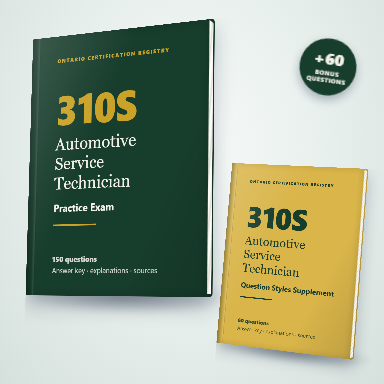 310SAutomotive Service Technician
 310TTruck and Coach Technician
 332AHairstylist
 442AIndustrial Electrician
 308ASheet Metal Worker
 415ACook
 456AWelder
 429AGeneral Machinist
 339AMobile Crane Operator
 339BTower Crane Operator